Setup Your First Agent
Build your first AIVAH agent in five short steps. This walkthrough mirrors the live product flow: create an agent, give it a face and a voice, test it in the Playground, share it publicly, and wire it up to your tools.Step 1: Create Your Agent
Open Agents in the side navigation (/agents) and click the + button to start a fresh agent at /agents/create.
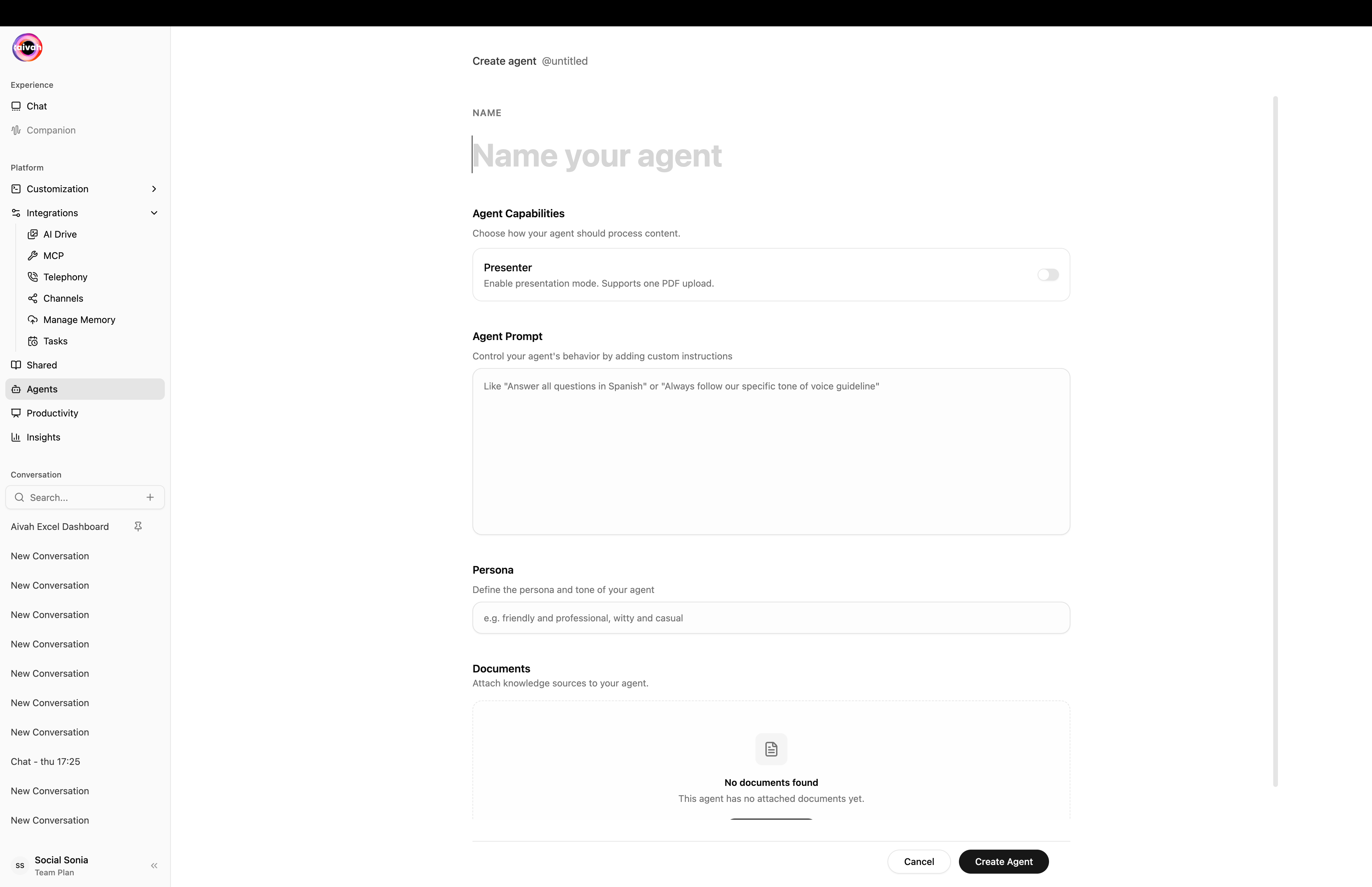
Create agent form – Name, Agent Capabilities, Agent Prompt, Persona, and Documents
Configure the basics
- Name – becomes the slug shown next to the heading (
@my-agent). - Agent Capabilities → Presenter – leave off for a knowledge-base agent that accepts URLs, files, and text. Turn on for a presenter that takes a single PDF or video and produces slide-aligned answers with a built-in Quiz overlay.
- Agent Prompt – freeform instructions that shape behaviour.
- Persona – a short label of your agent’s tone (for example witty and casual).
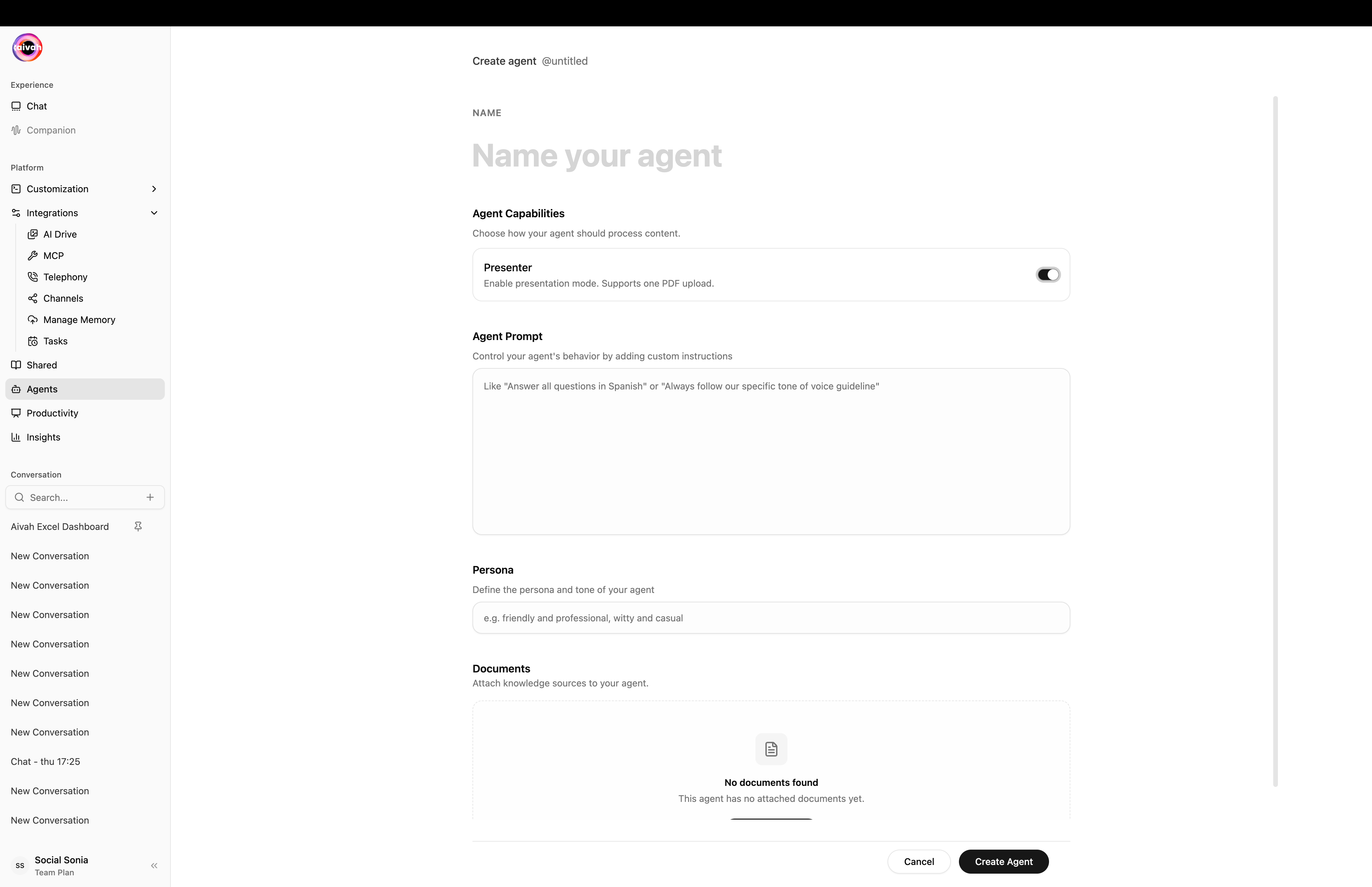
Presenter toggle on – this constrains the agent to a single PDF or video and unlocks the Quiz overlay
Add knowledge content
Click Add document to attach knowledge sources. Knowledge-base agents accept any mix of URL / Files / Text; presenter agents accept a single PDF or video.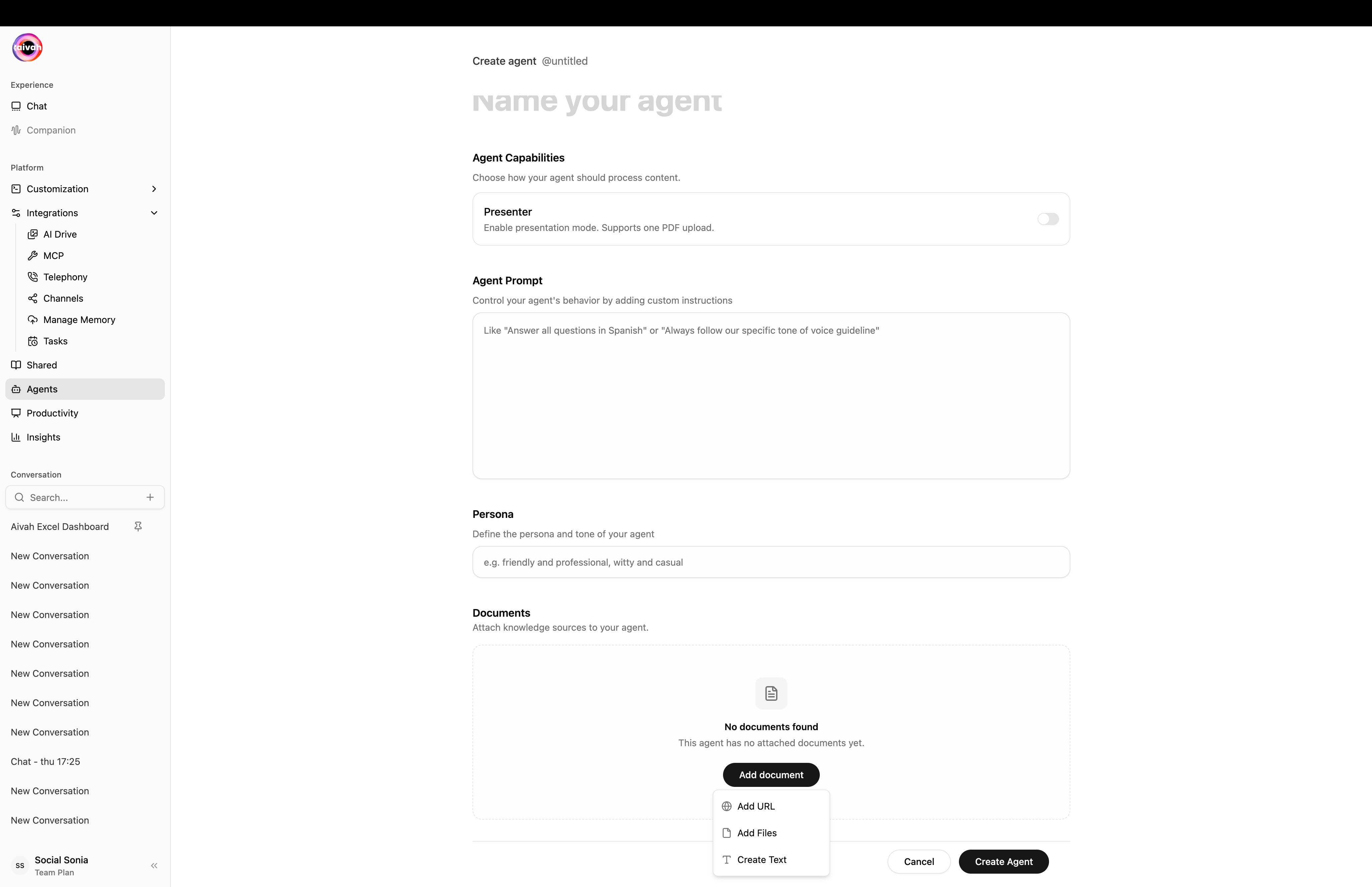
Add document dropdown – Add URL, Add Files, or Create Text
- Add URL
- Add Files
- Create Text
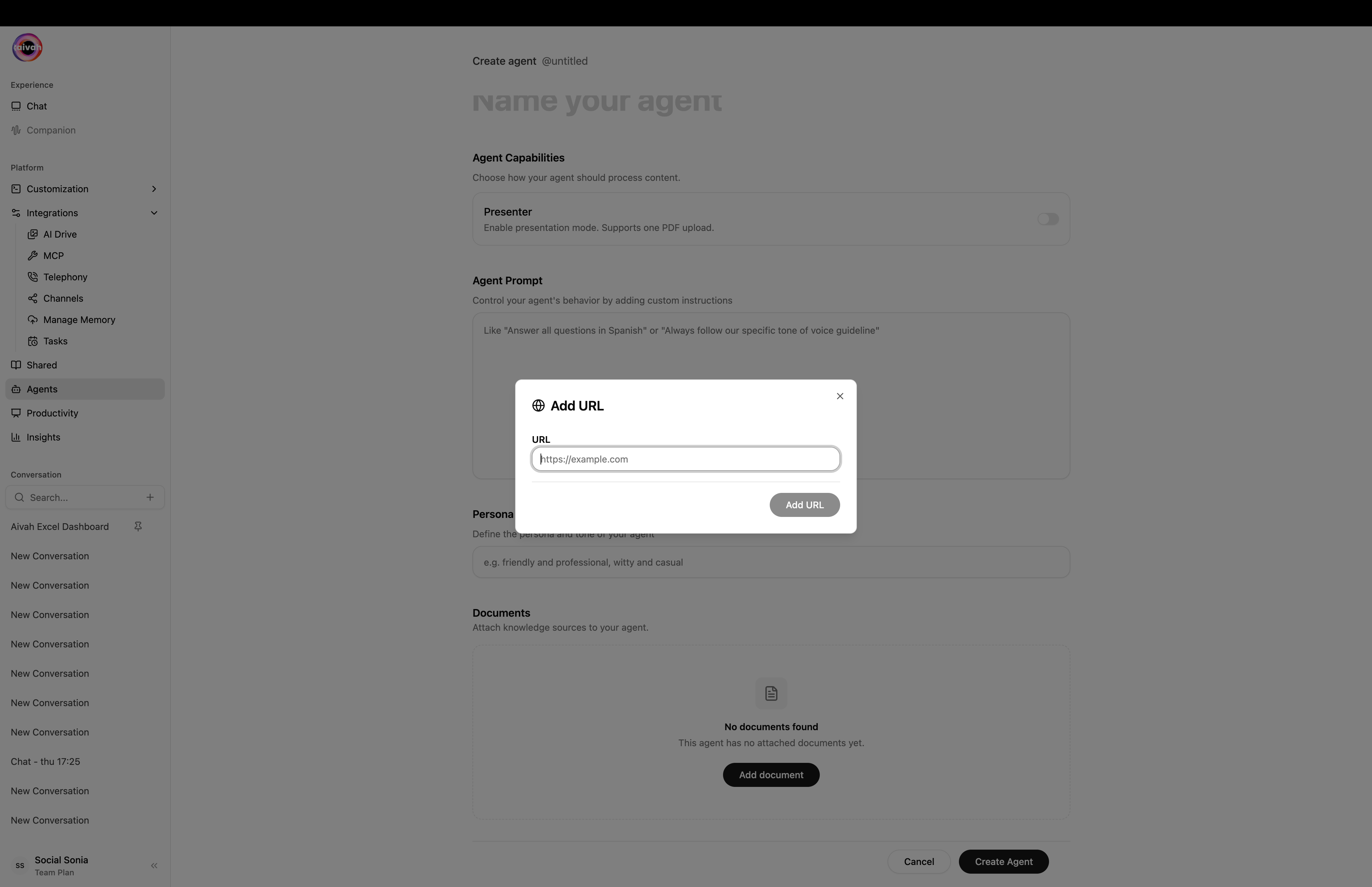
Add URL modal
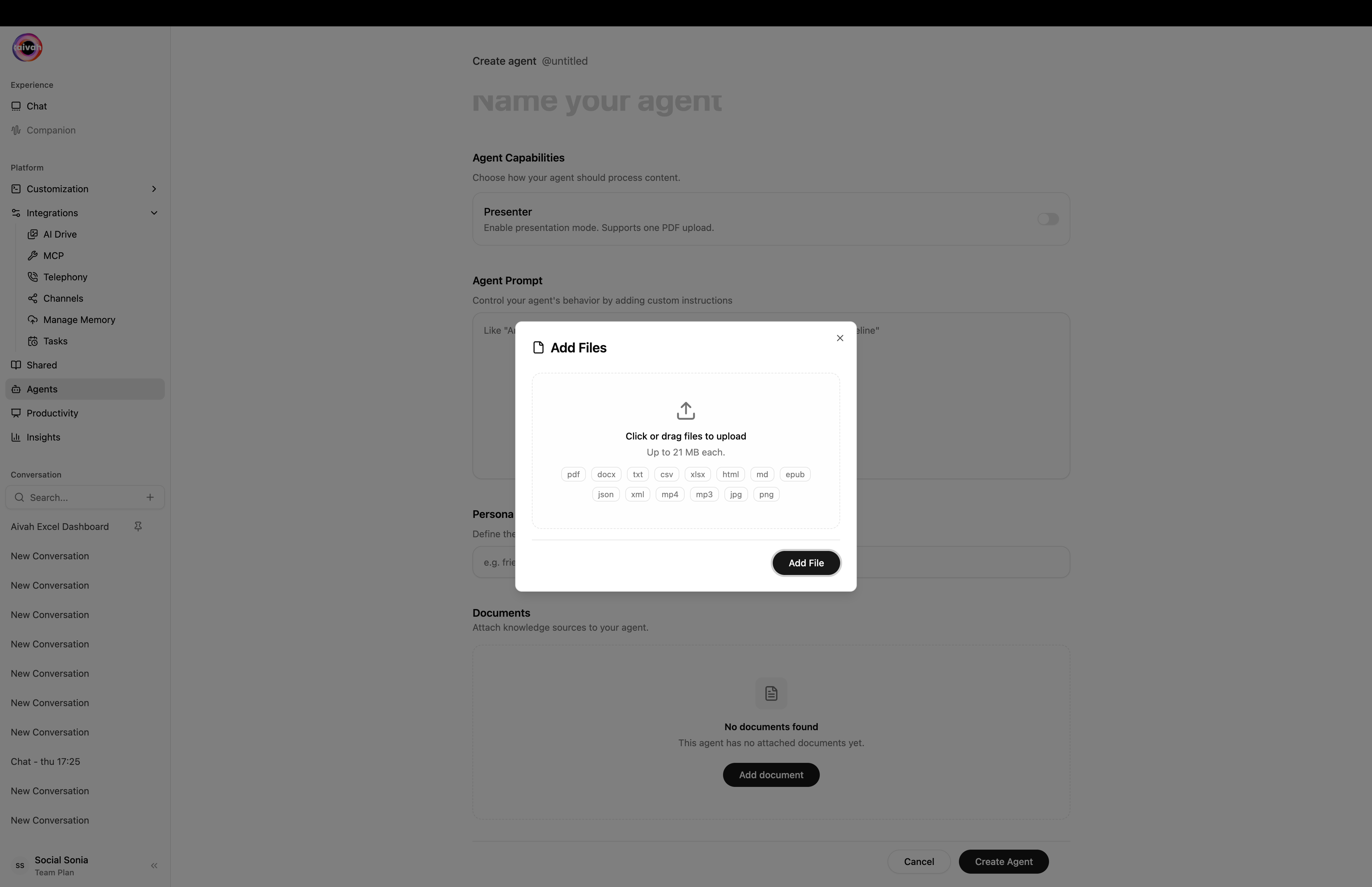
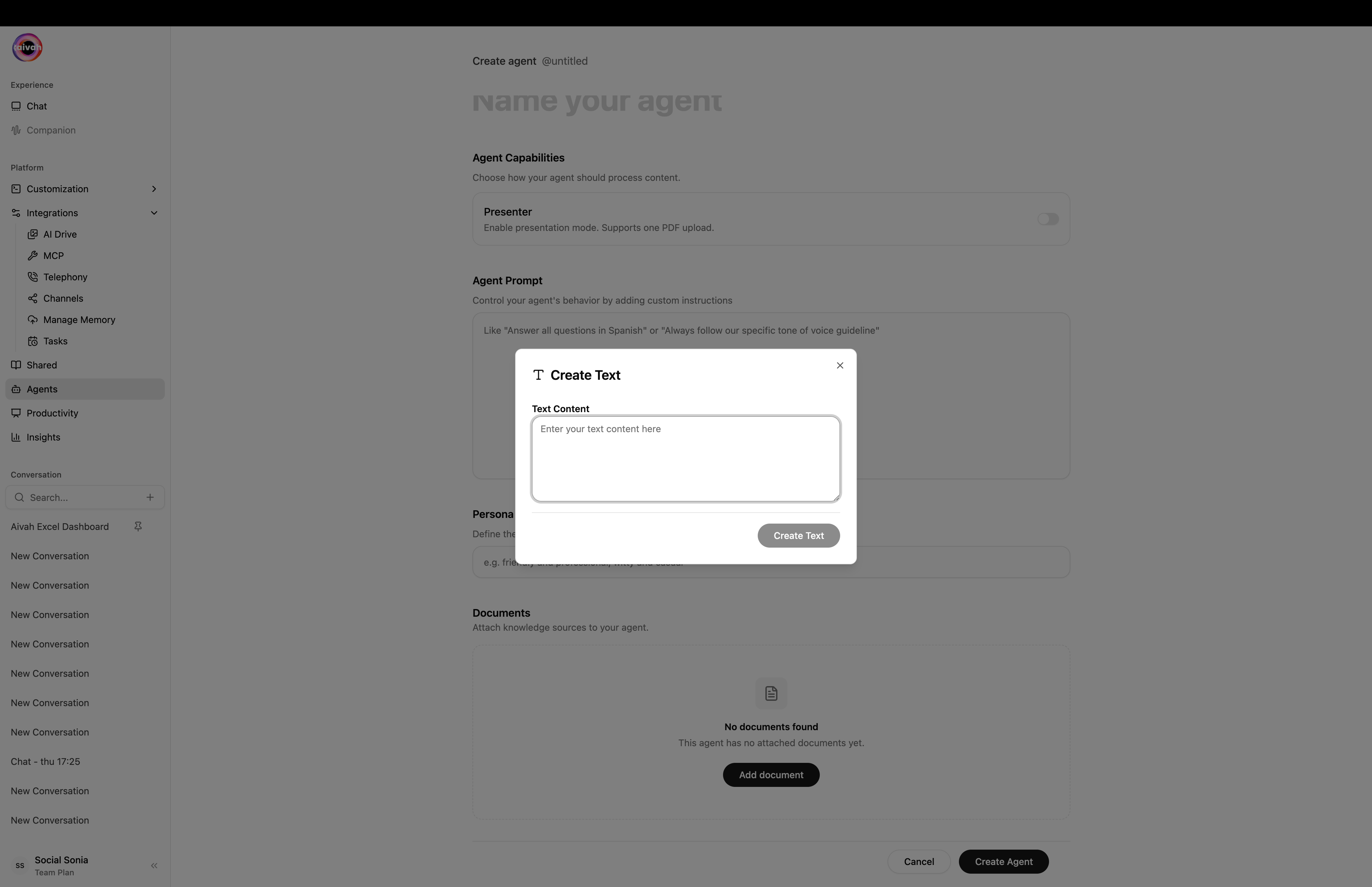
Finalise
Click Create Agent. The agent entersprocessing, you’re redirected to the agents list, and Aivah polls every few seconds until the status flips to completed. If a single source fails, open the agent detail view and hit the inline refresh on just that item.
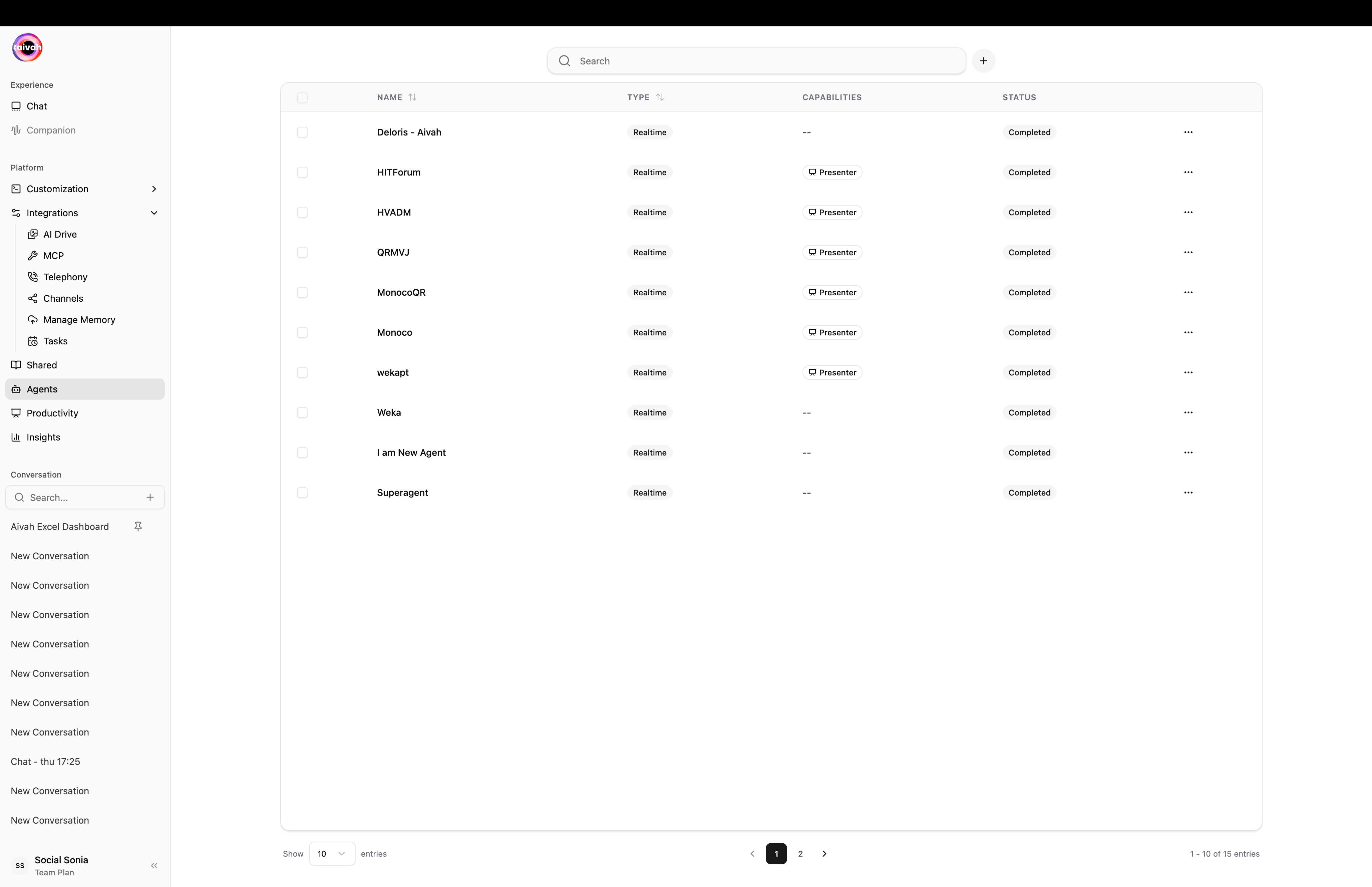
Agents workspace – every agent with its type, capability badges, and live training status
Step 2: Pick a Persona – Avatar, Character, and Voice
Aivah keeps everything visual in one workspace:Side nav → Customization.
Avatars (3D)
Browse the full Ready Player Me-based avatar library and set defaults fromCustomization → Avatars.
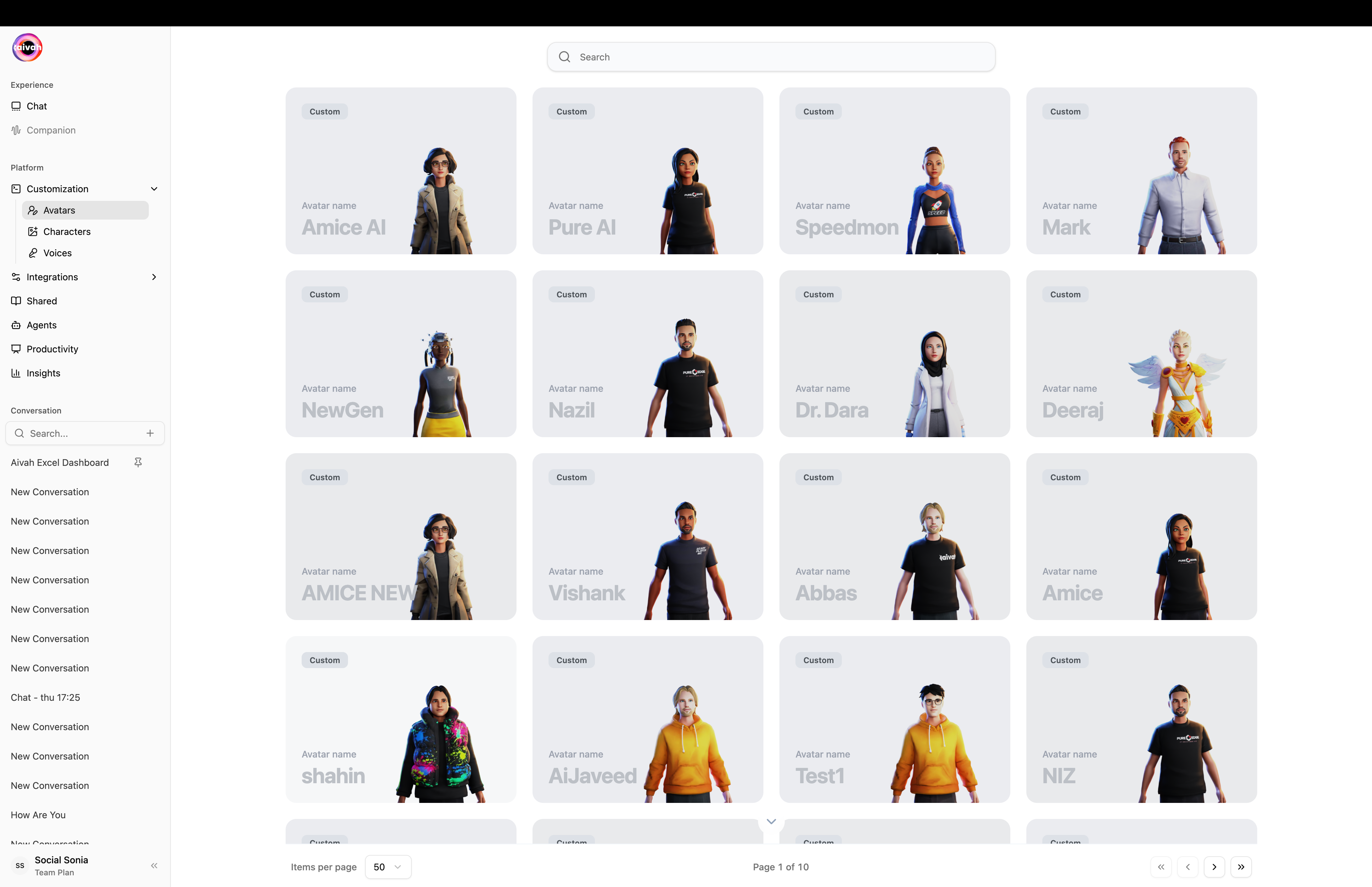
Avatars grid – every 3D companion in your account
Characters (2D)
Characters are lightweight image-based personas – upload a photo, crop it, name it, and it’s instantly selectable everywhere a character can be picked.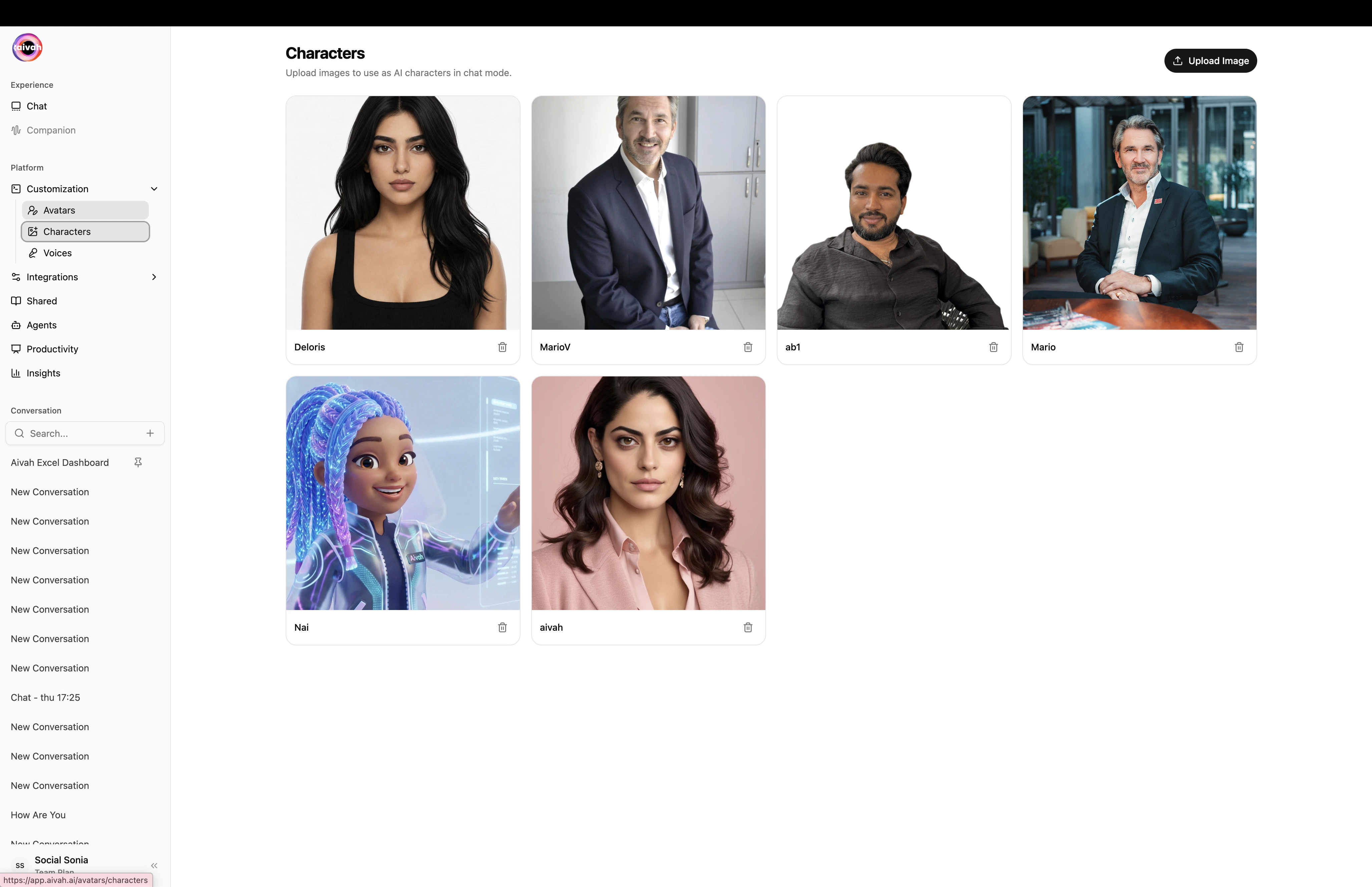
Characters page – upload an image and it becomes a selectable 2D persona
Click Upload Image
Customization → Characters and pick a photo. JPG, PNG, and WEBP are supported.Crop the face
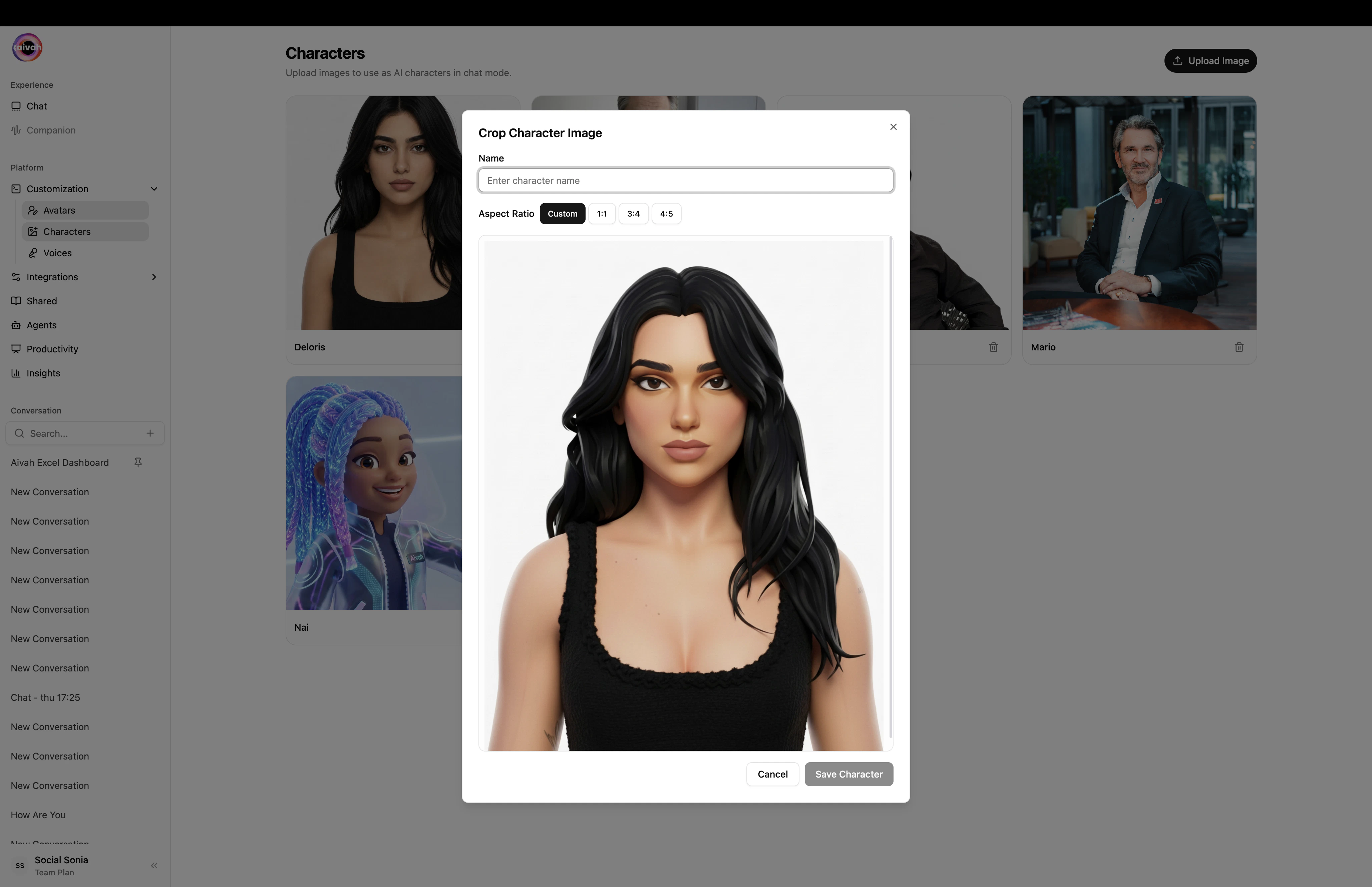
Crop Character Image modal
Edit or delete anytime
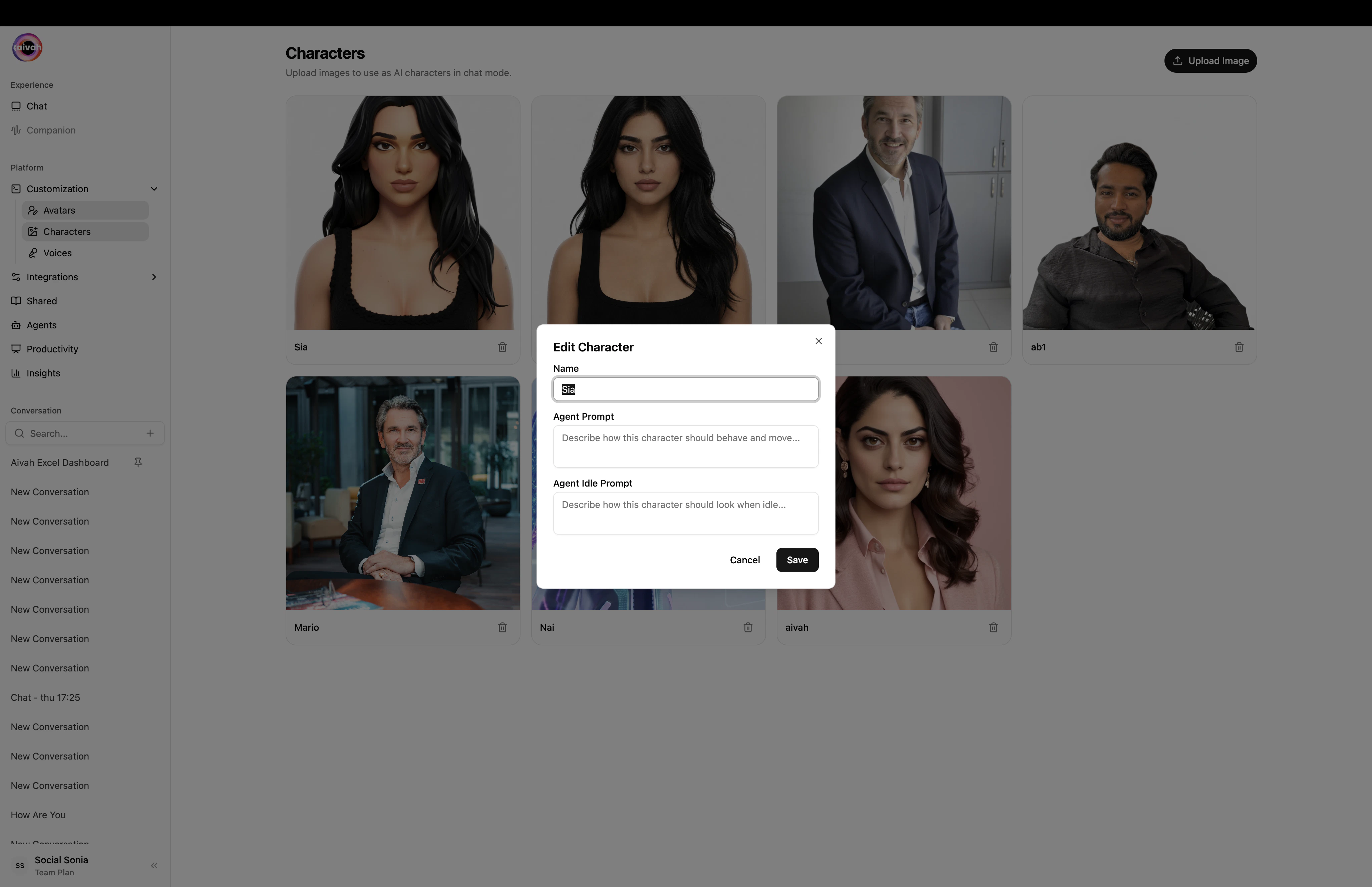
Edit Character modal
Voices
Customization → Voices lists every built-in voice plus any clones you’ve made. Click + Create to add your own.
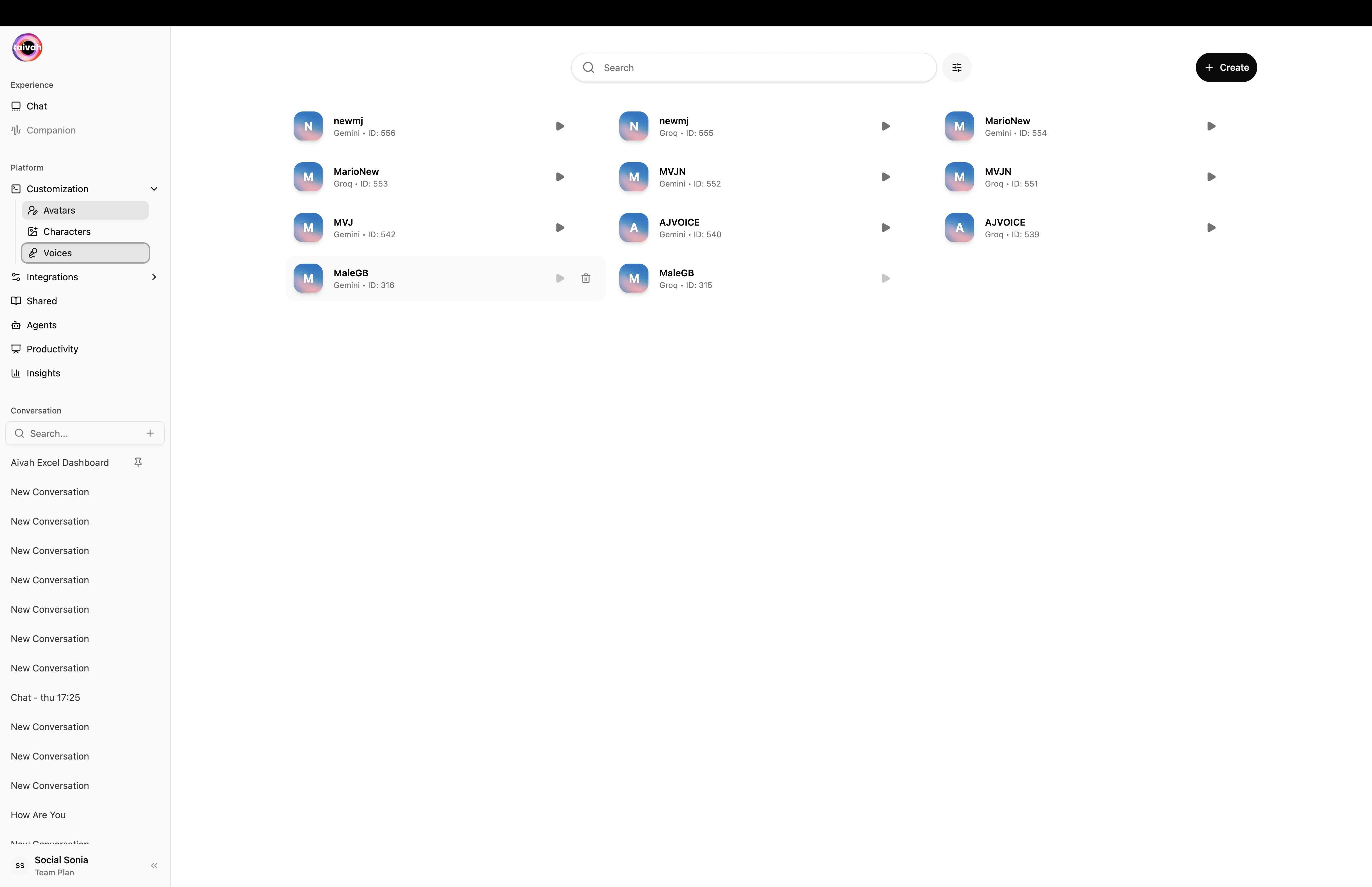
Voices page – built-in voices plus your private clones
Open the Add voice modal
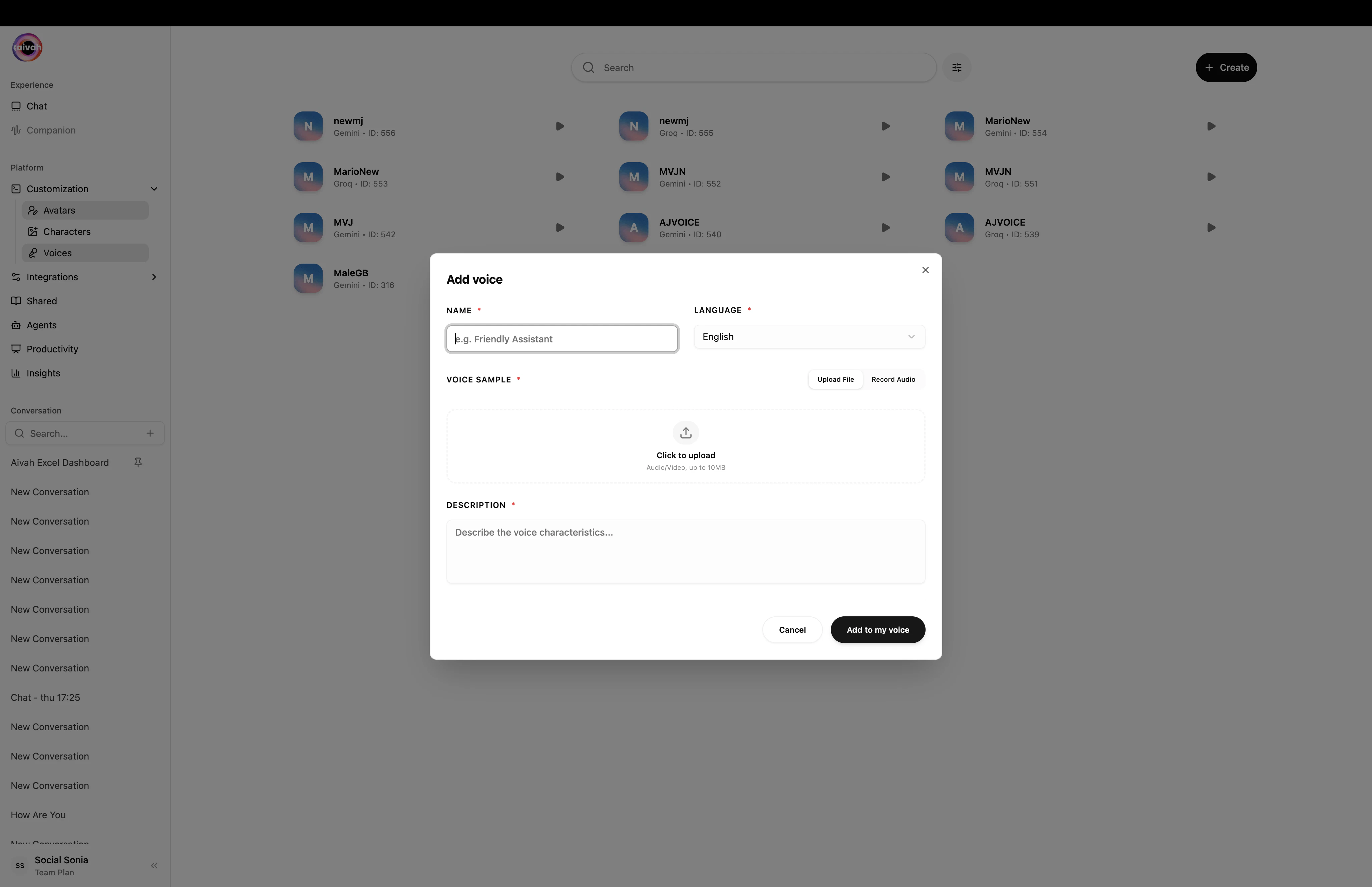
Add voice modal – Name, Language, Voice Sample, and Description
Pick the language
Upload or record a sample
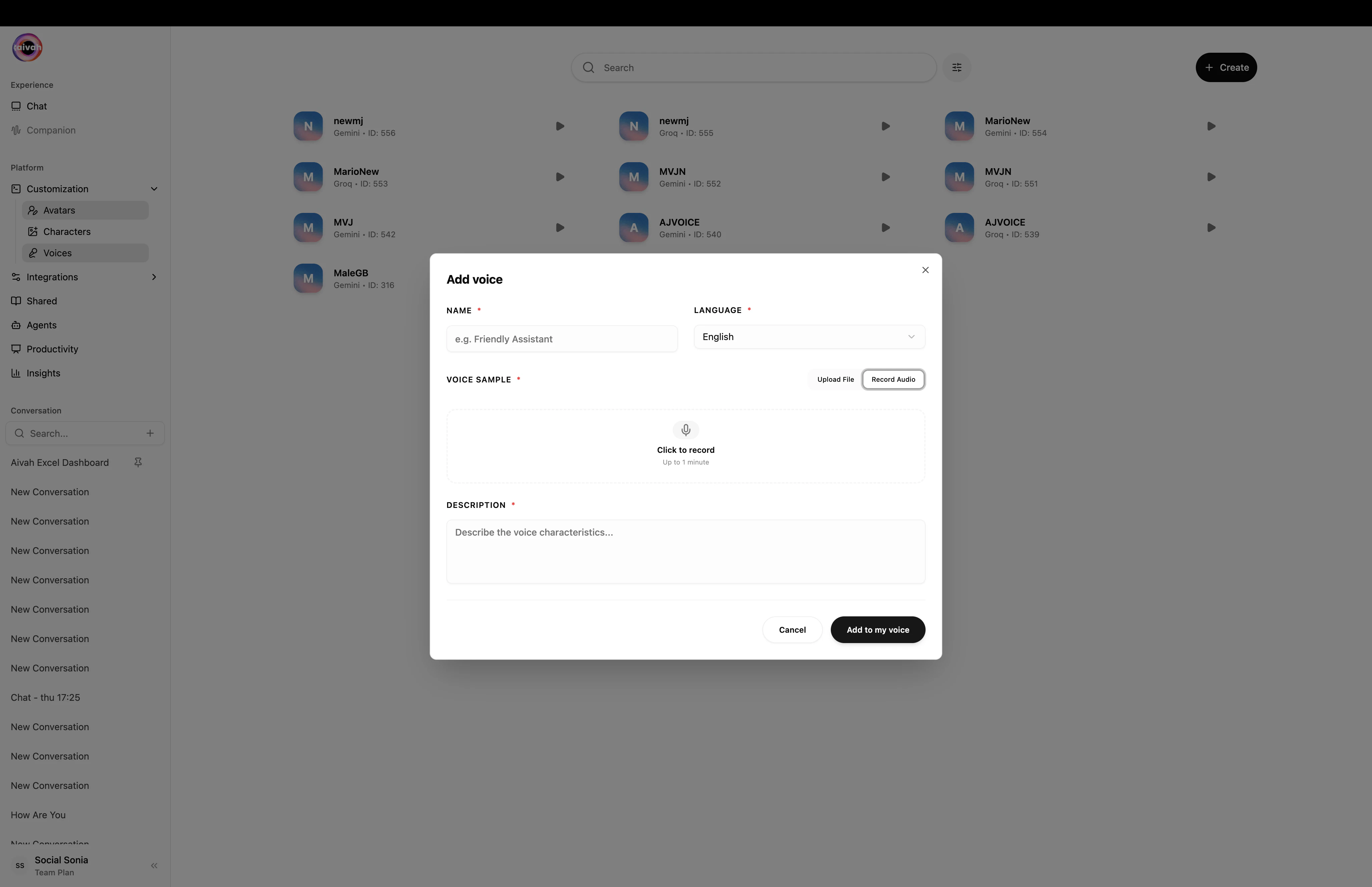
Record Audio mode – capture up to 1 minute right in the browser
Save
Step 3: Test in the Playground
Open the Chat workspace from the side navigation. New chats start at/new-playground/new-chat; existing conversations live at /{conversationId}/chat and /{conversationId}/avatar-chat.
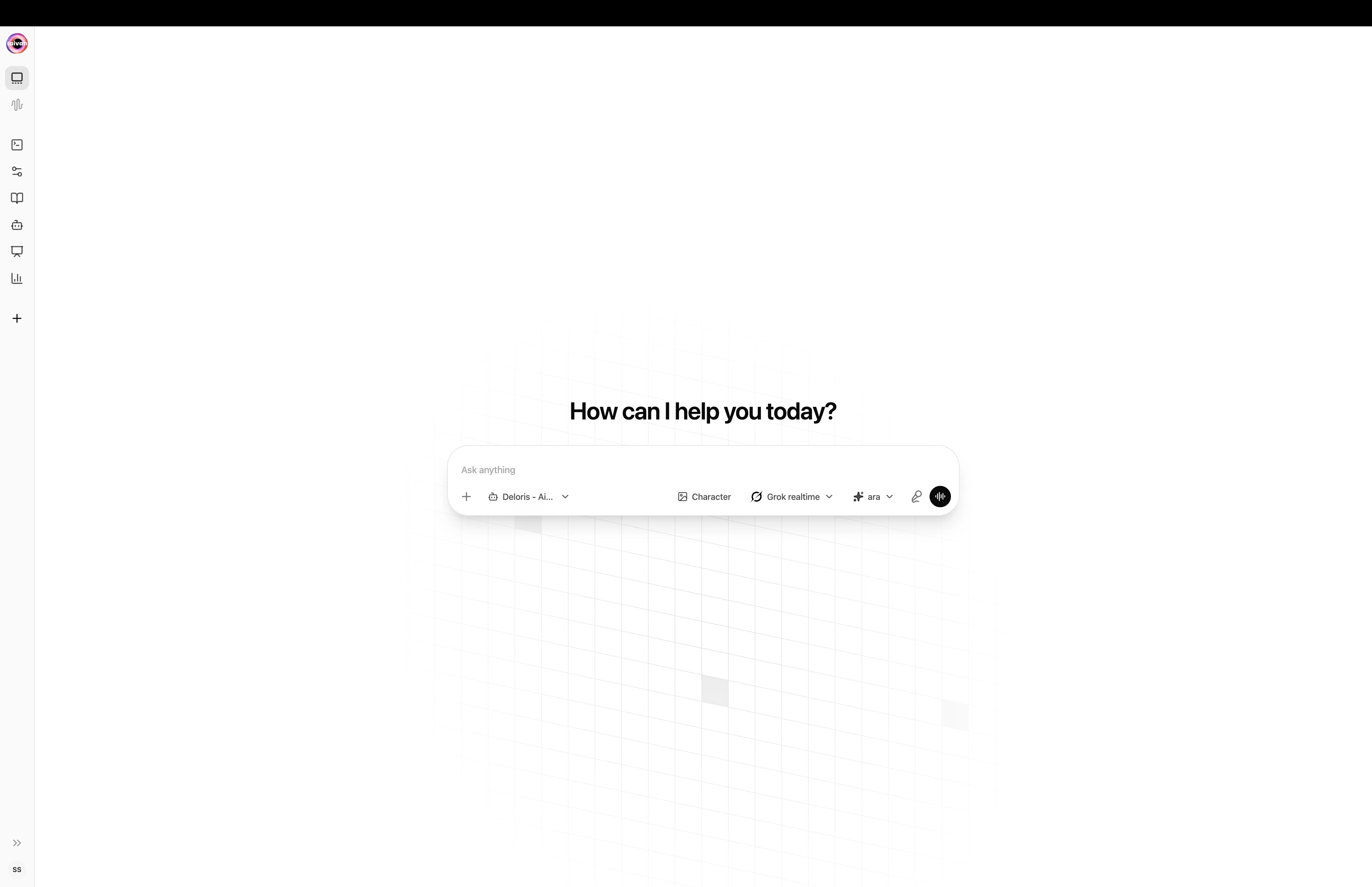
New chat composer – pick agent, character, model, and voice from the pills
Configure the conversation from the composer pills
Every important option is one click away from the composer:- Agent
- LLM
- Voice
- Character
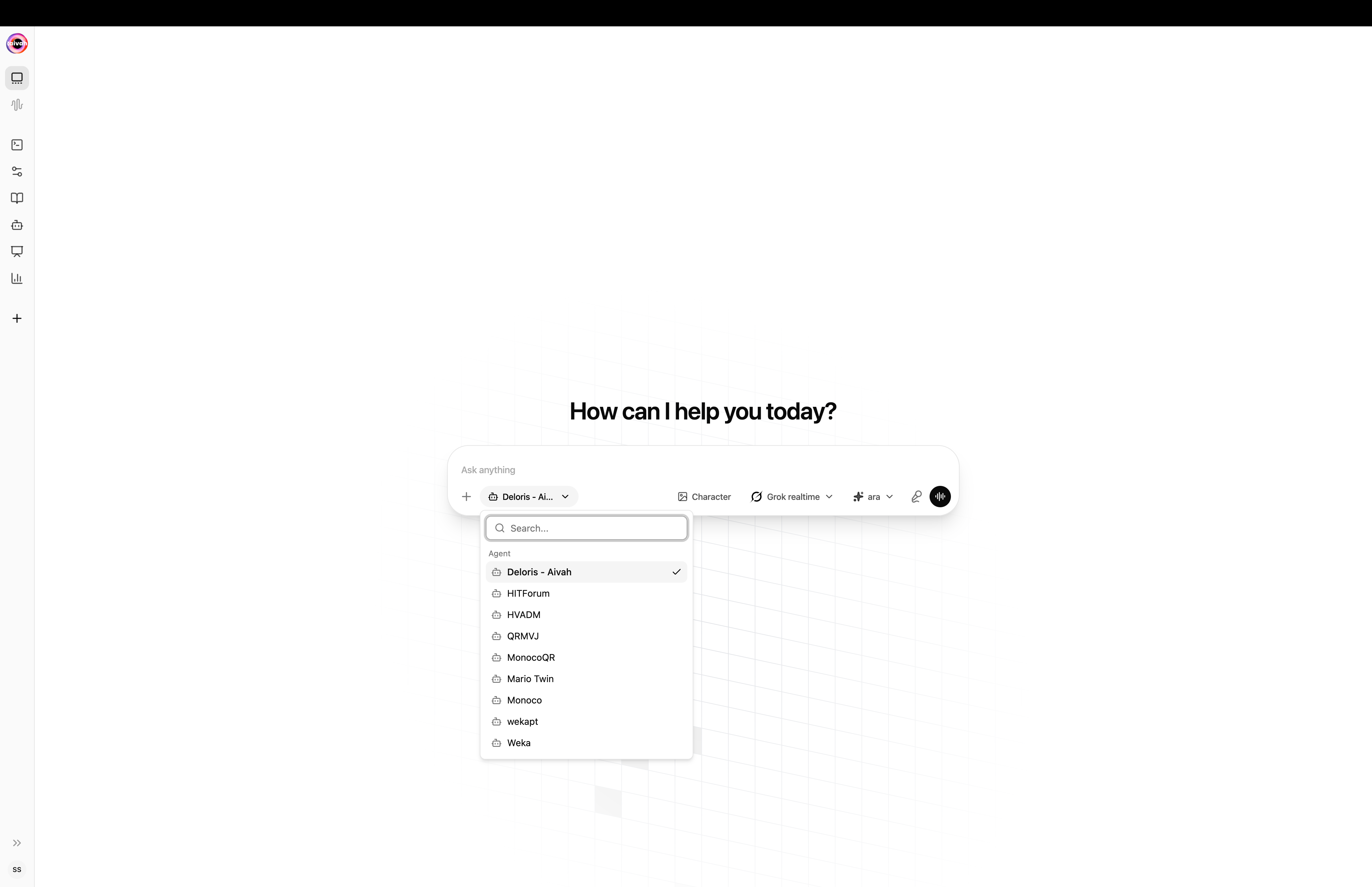
Switch the active agent without leaving the composer
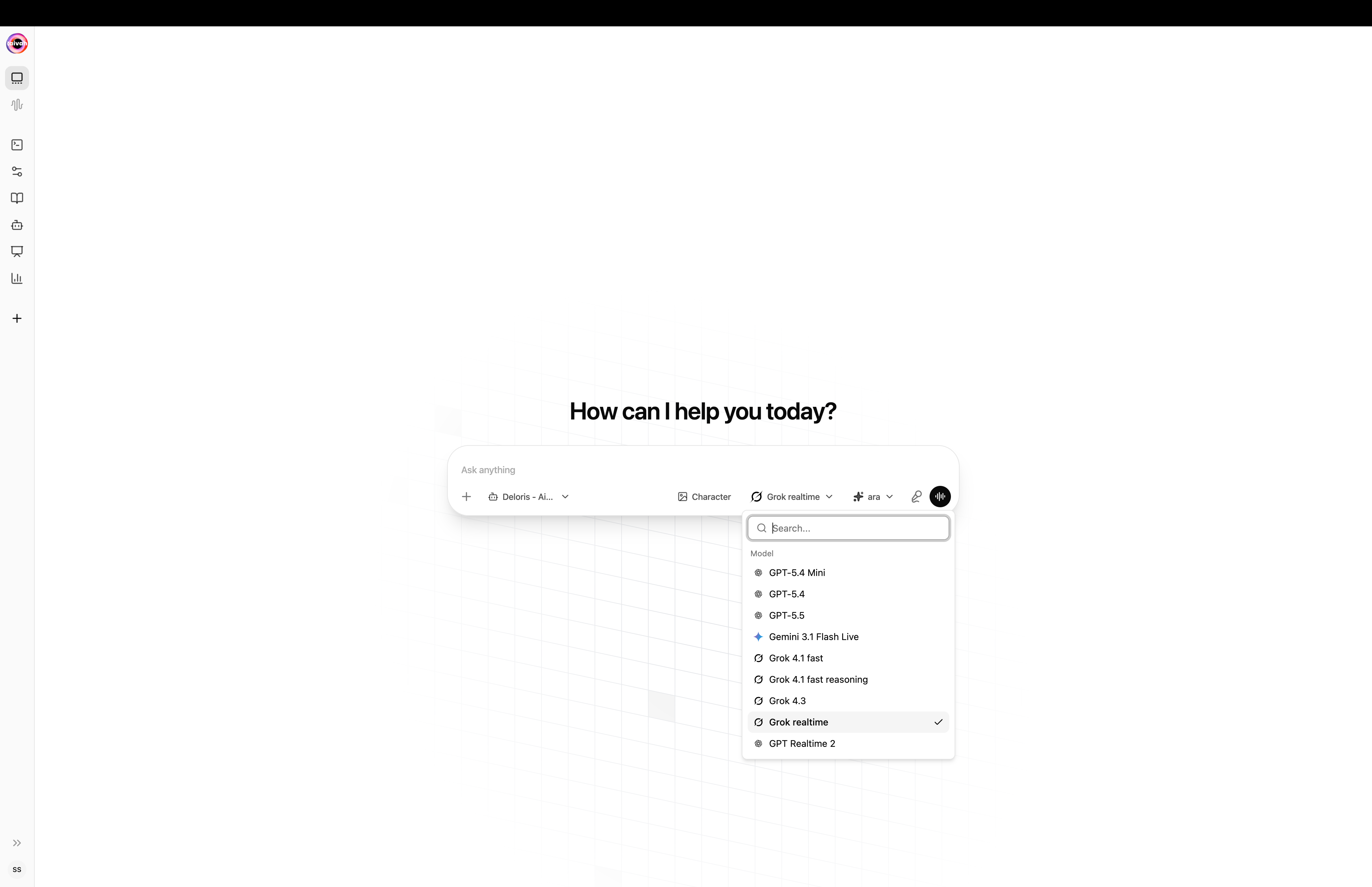
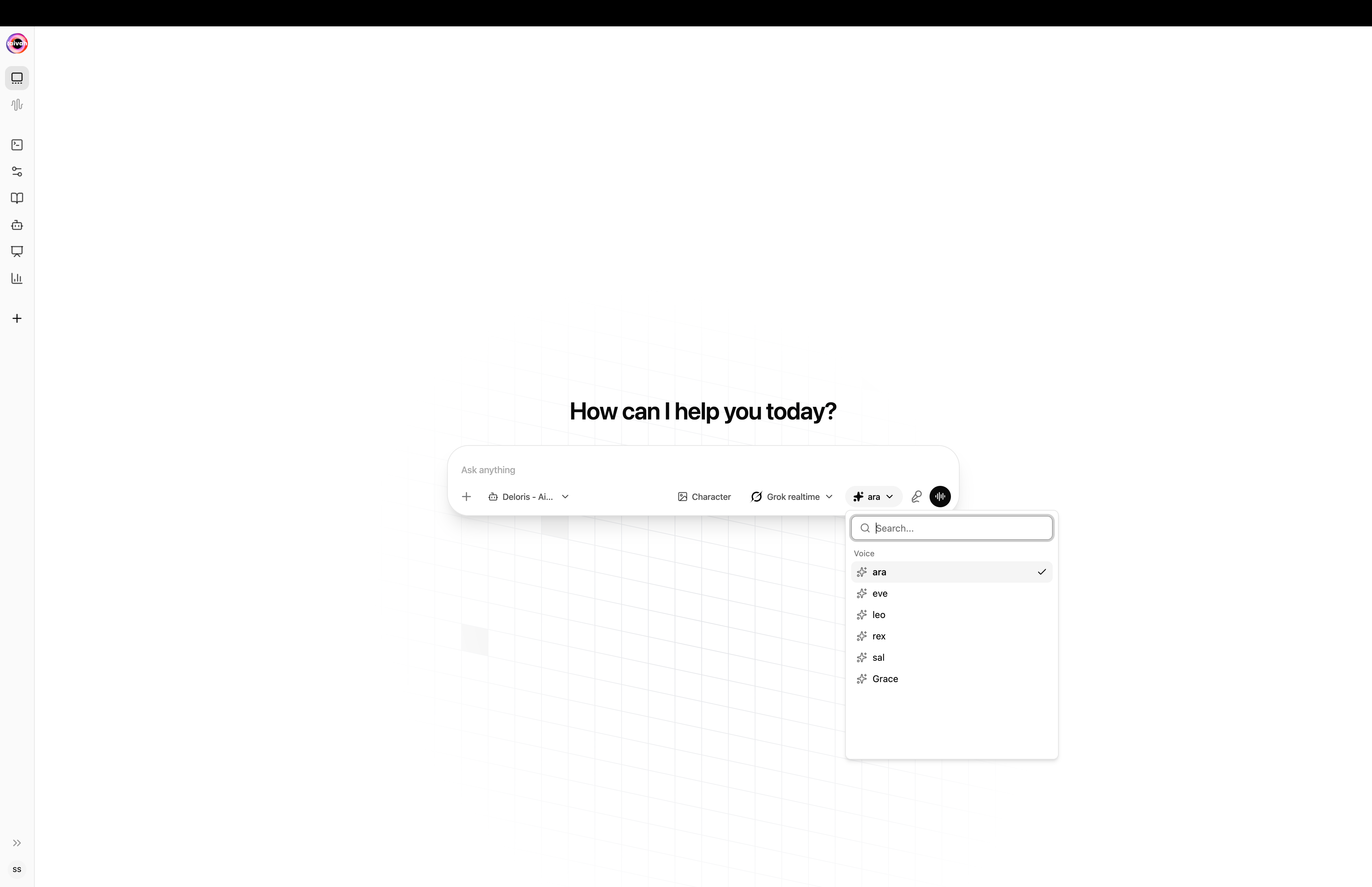
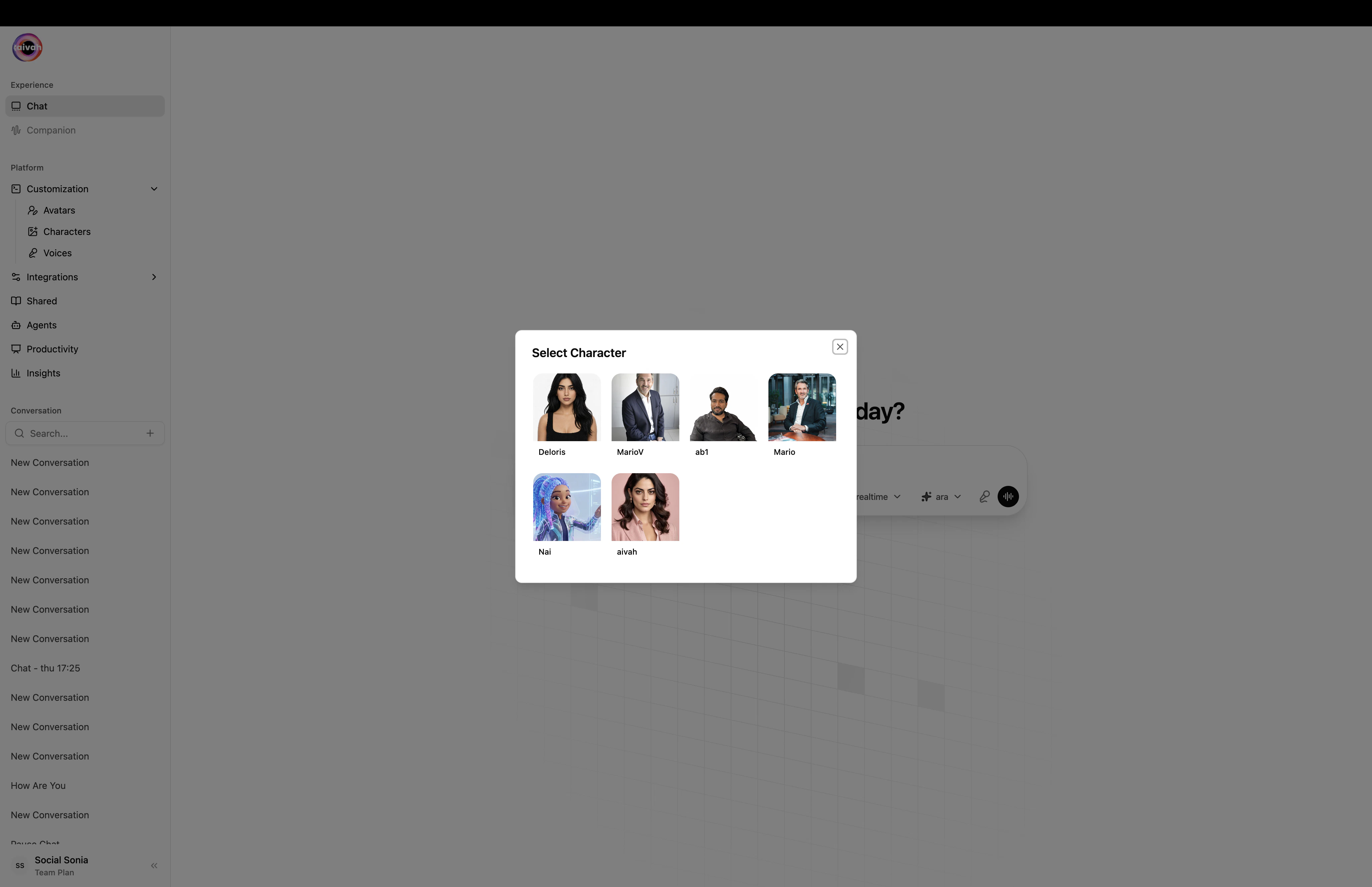
Try the three modes
- Text chat
- Avatar chat
- Voice-only
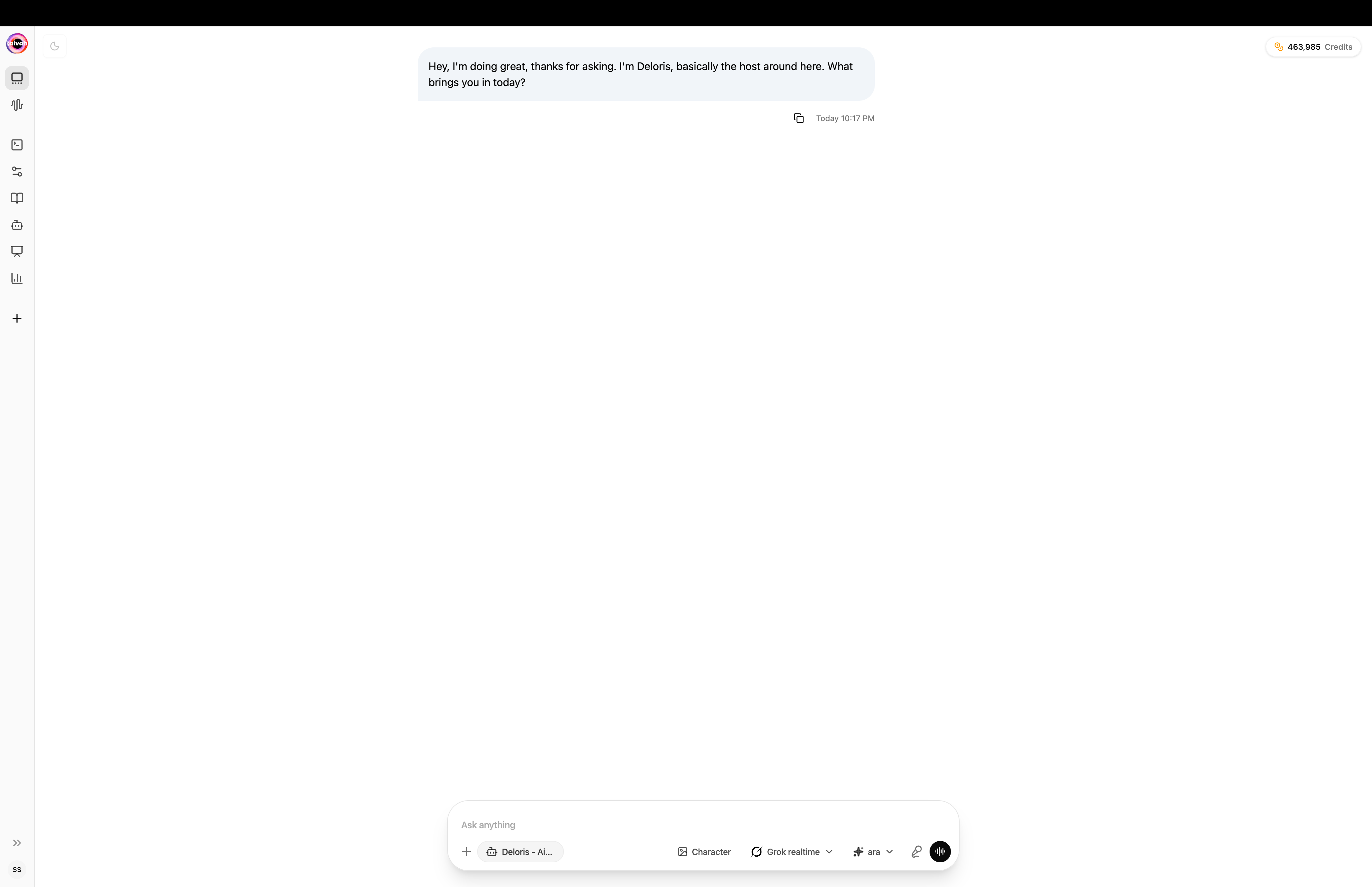
Text chat conversation with credits badge in the top-right
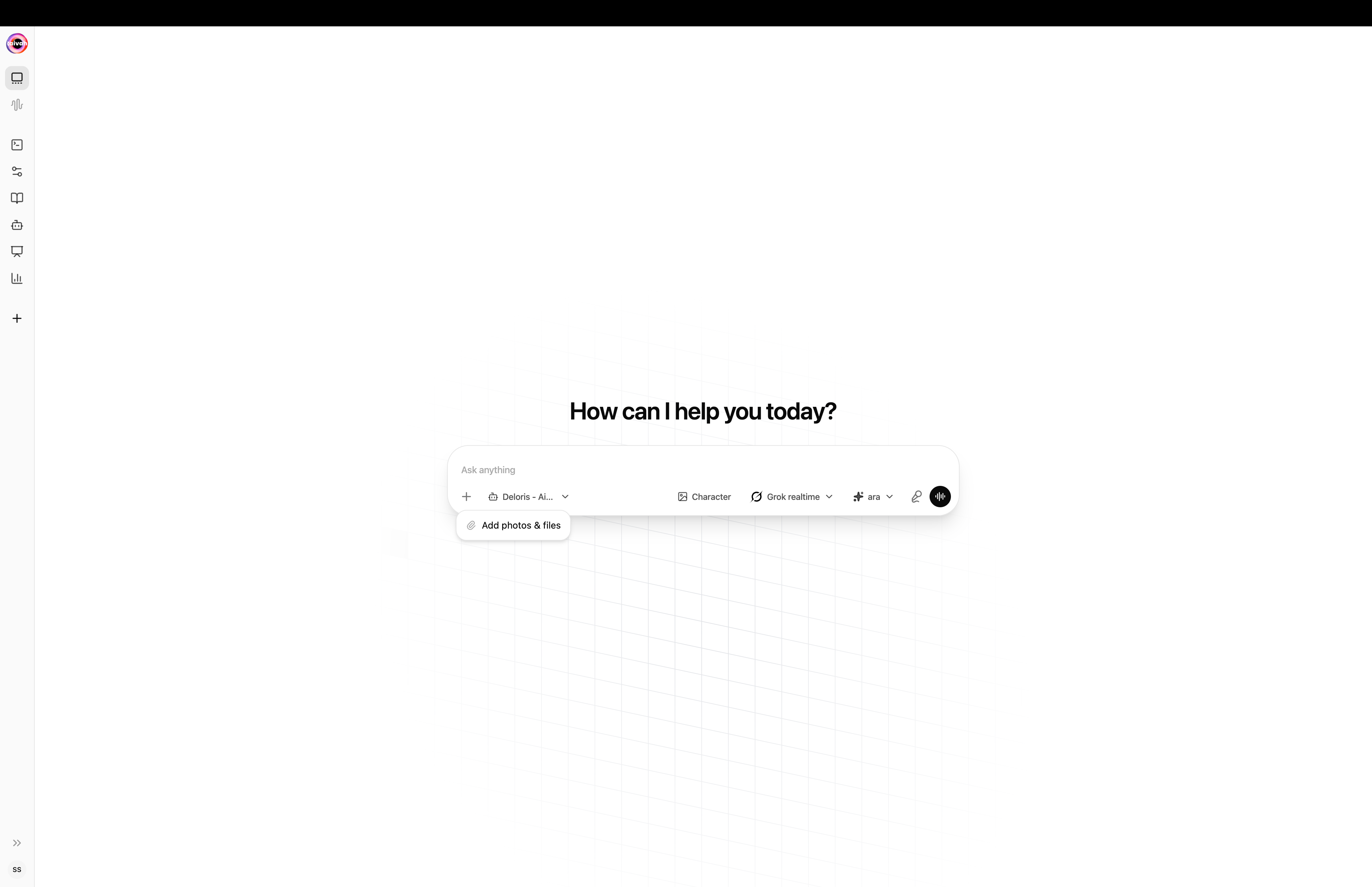
Add photos and files directly from the composer
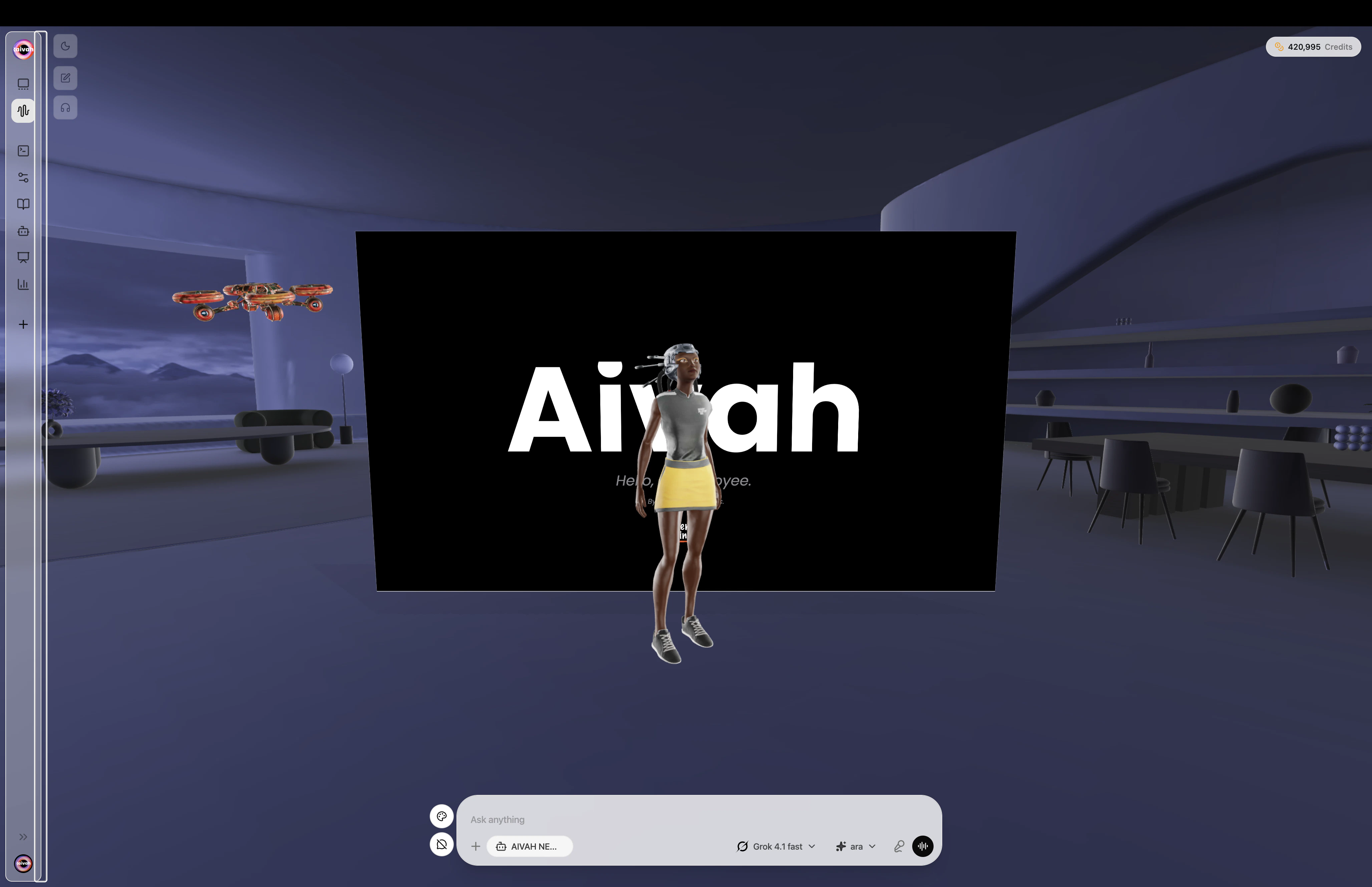
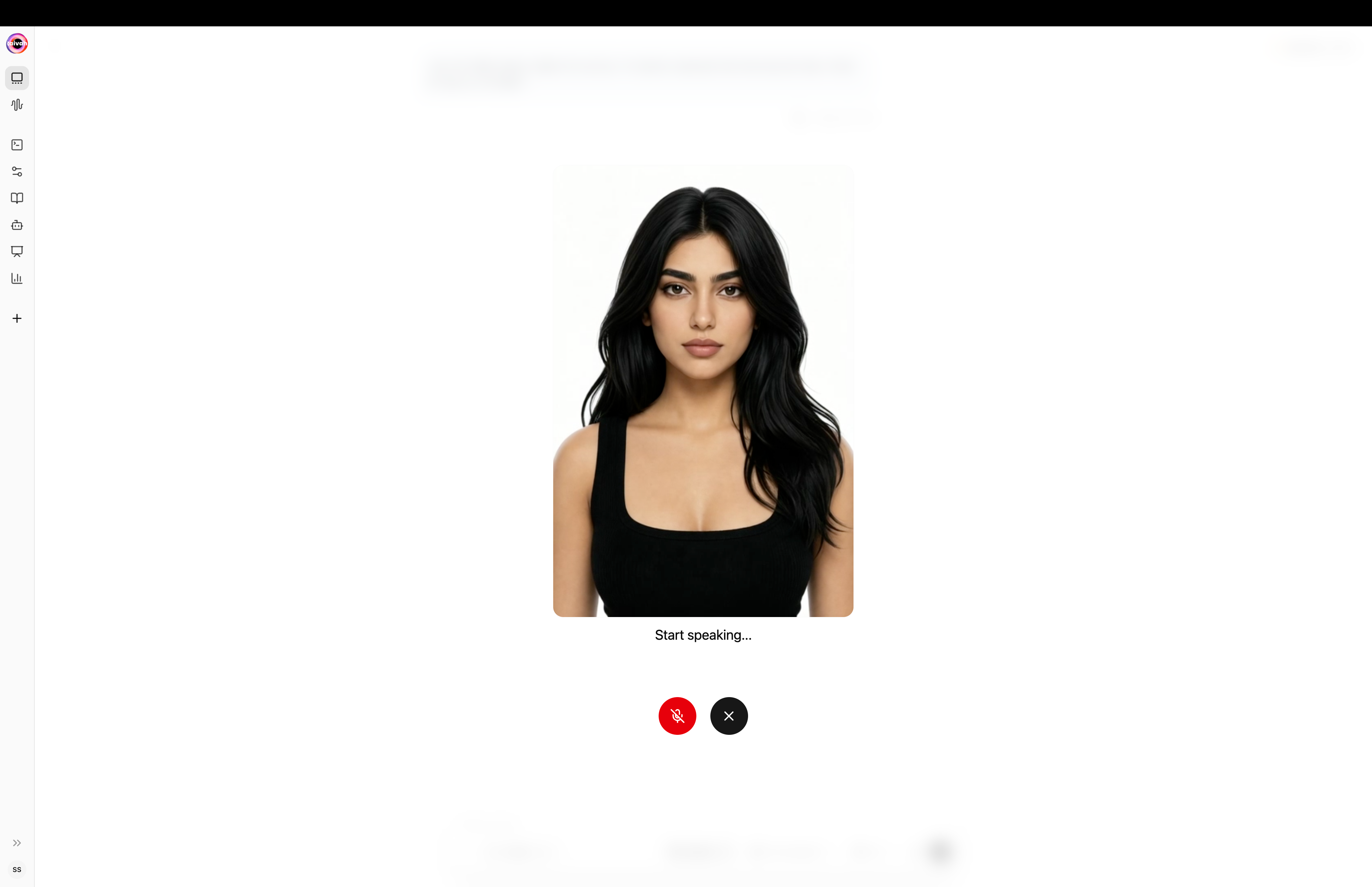
Generate media right from the composer
Ask the agent to draw, animate, or research – the chat composer routes the request to the right model automatically.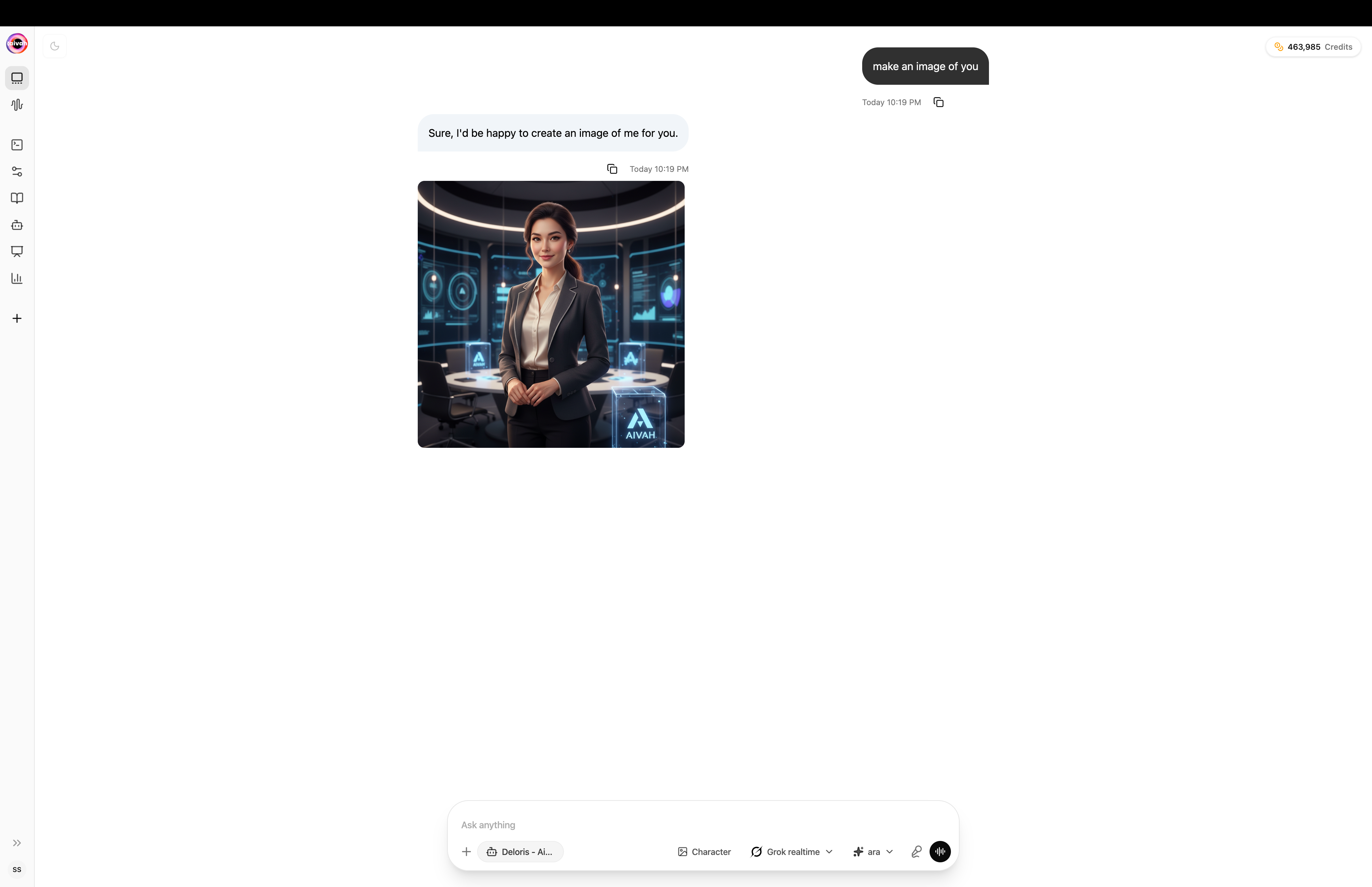
Image generation runs inline, then the result auto-saves to AI Drive
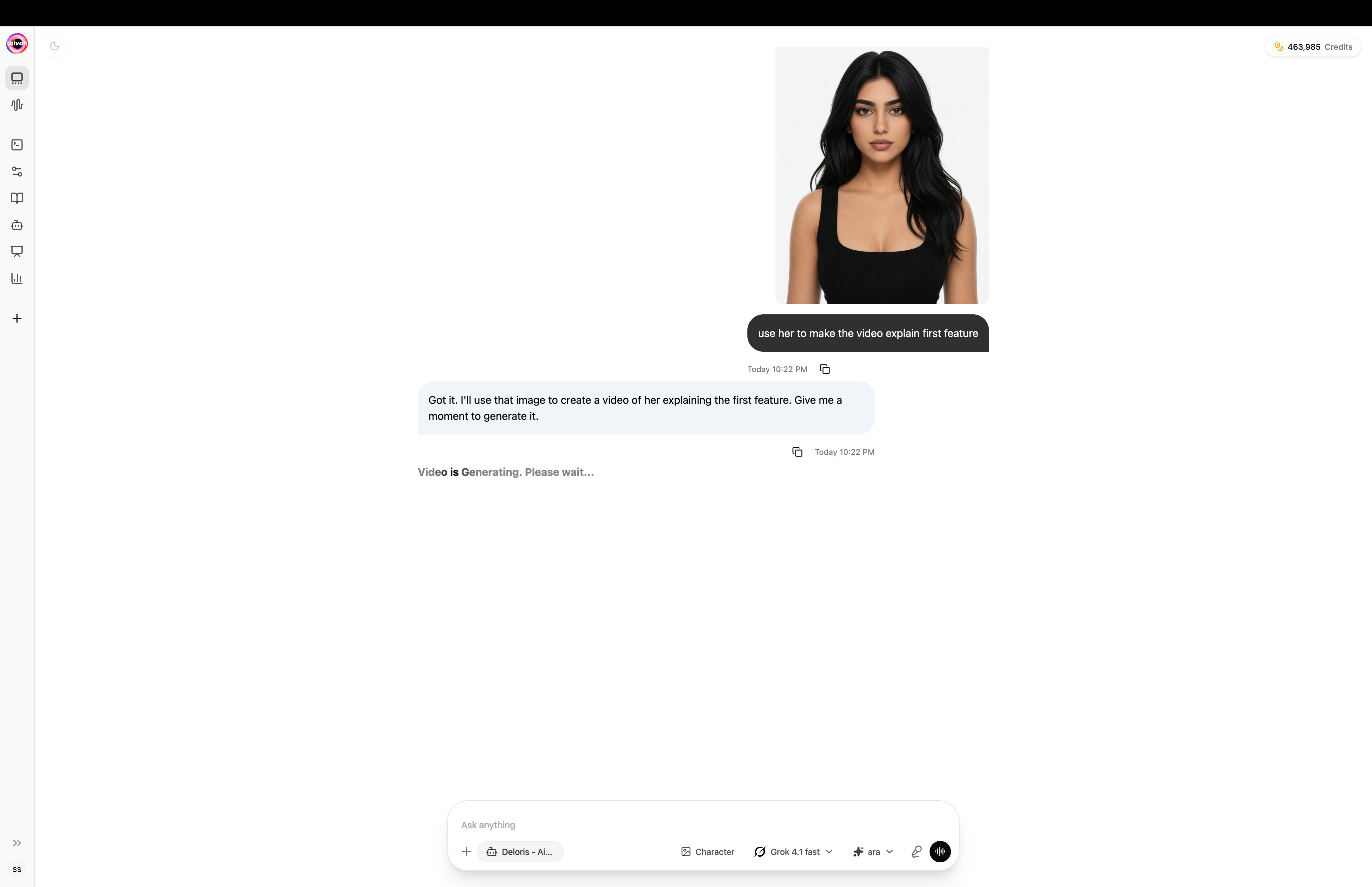
Animate any generated image into a short video with a follow-up prompt
Tune the avatar and scene from Preferences
The palette icon next to the composer opens Preferences. Use it to set the default avatar and the 3D scene the avatar chat opens in.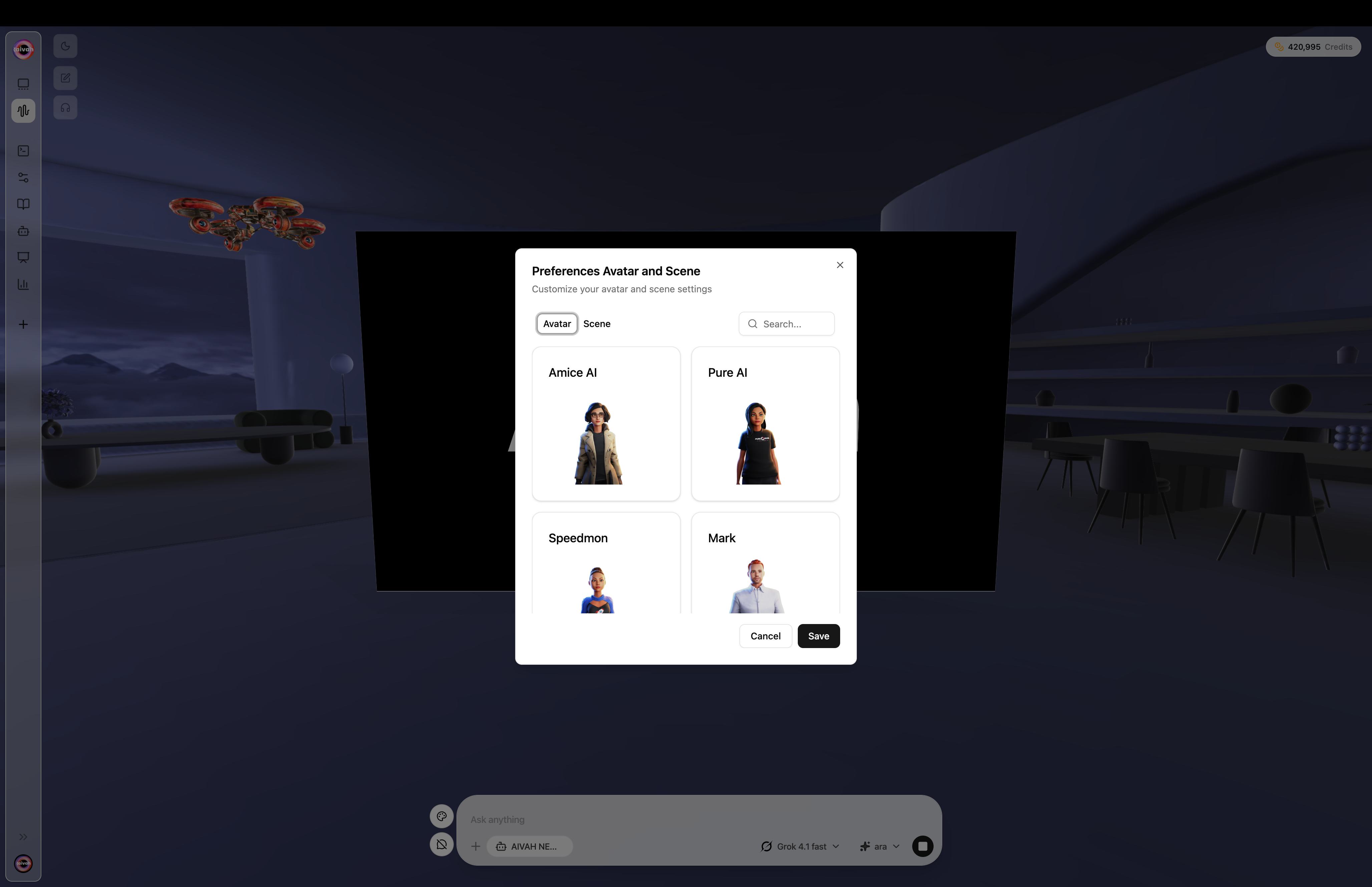
Preferences modal – Avatar tab
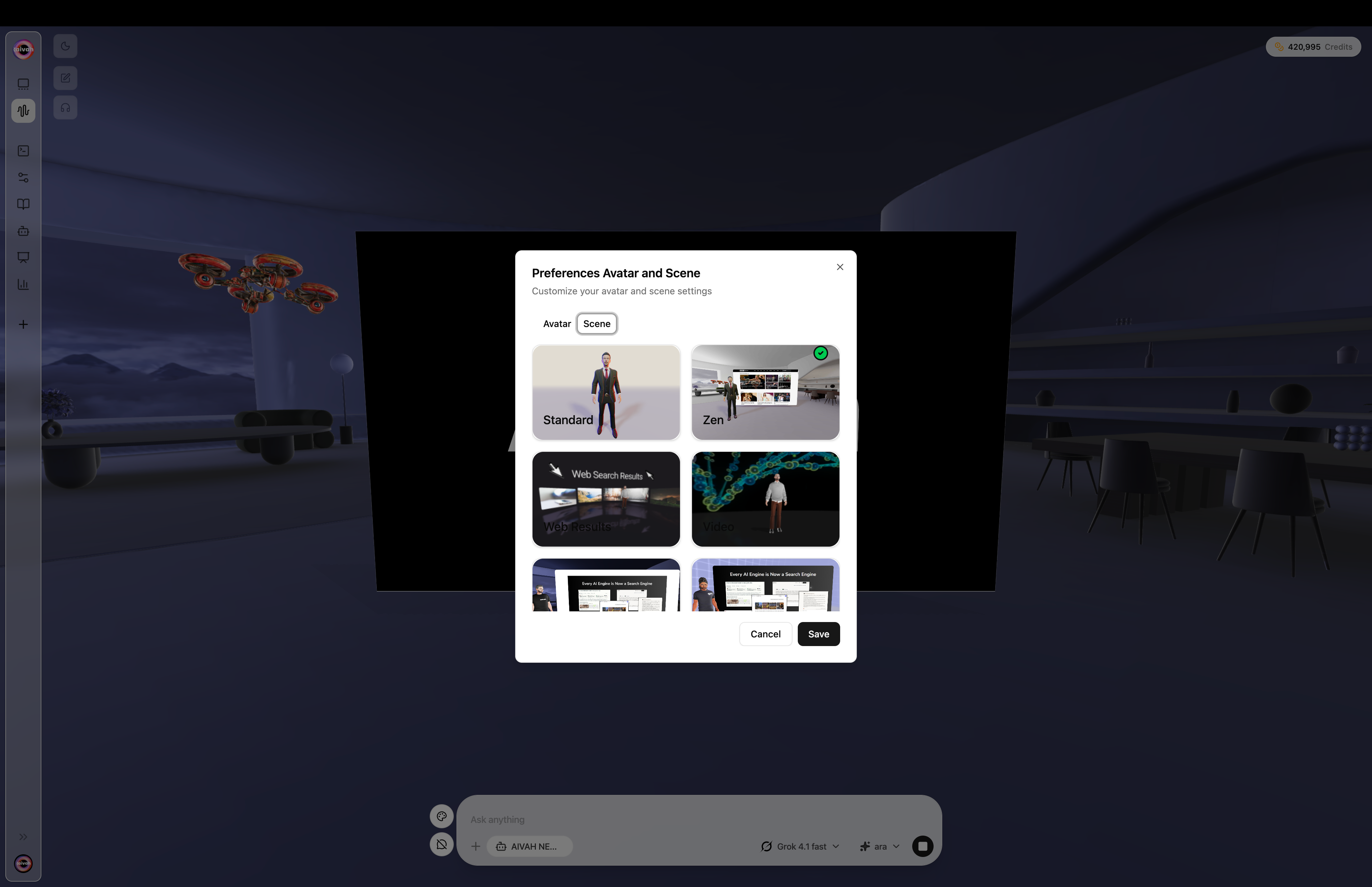
Preferences modal – Scene tab (Standard, Zen, Web Results, Video, Presenter)
Step 4: Share Your Agent
Open Shared in the side navigation to publish a public link, bubble, or iframe.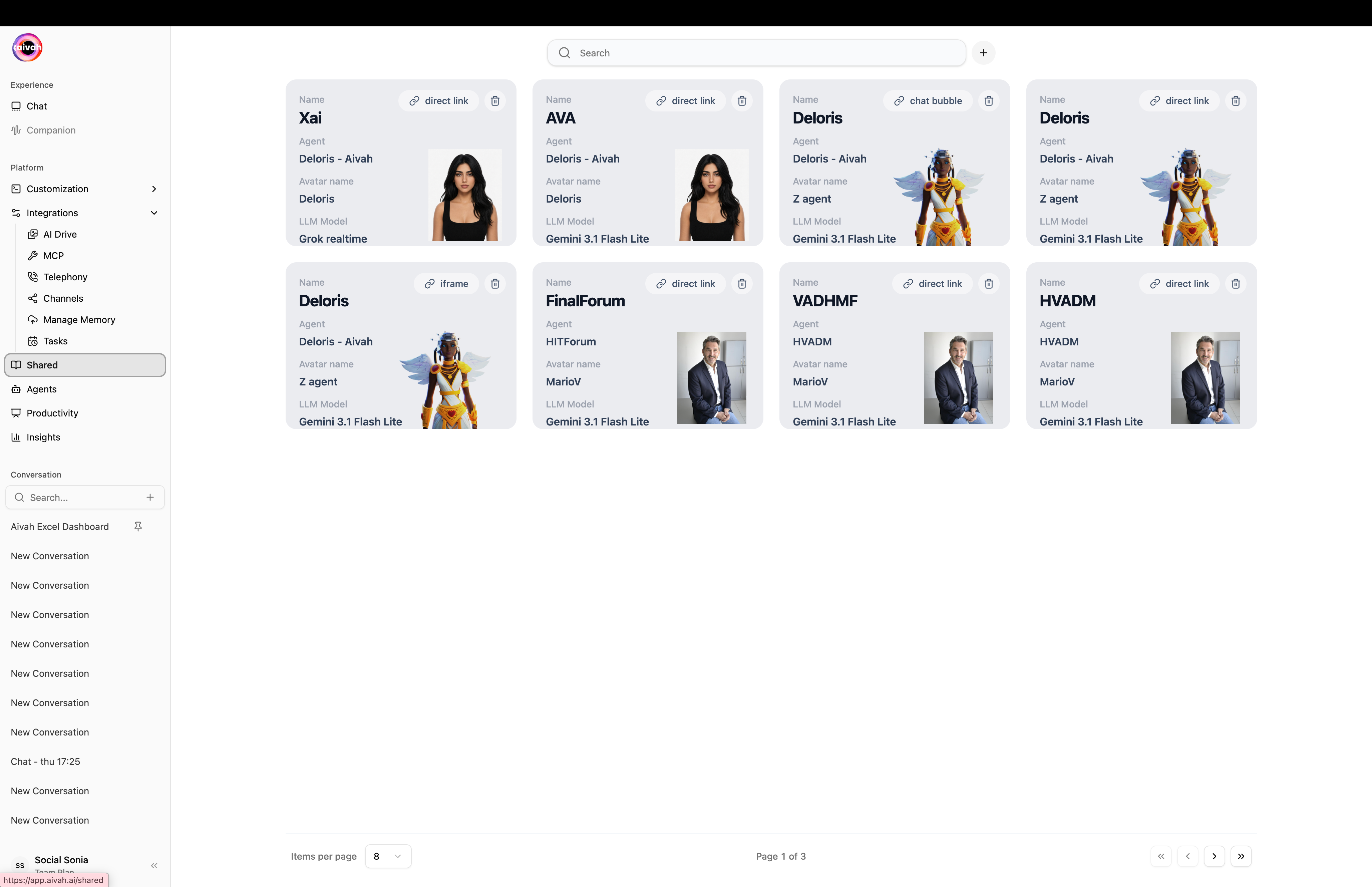
Shared workspace – every published agent with its link type badge
Create a shared agent
Click the + button to open the two-step create flow.Persona step – pick the agent, model, voice, tools, and instructions
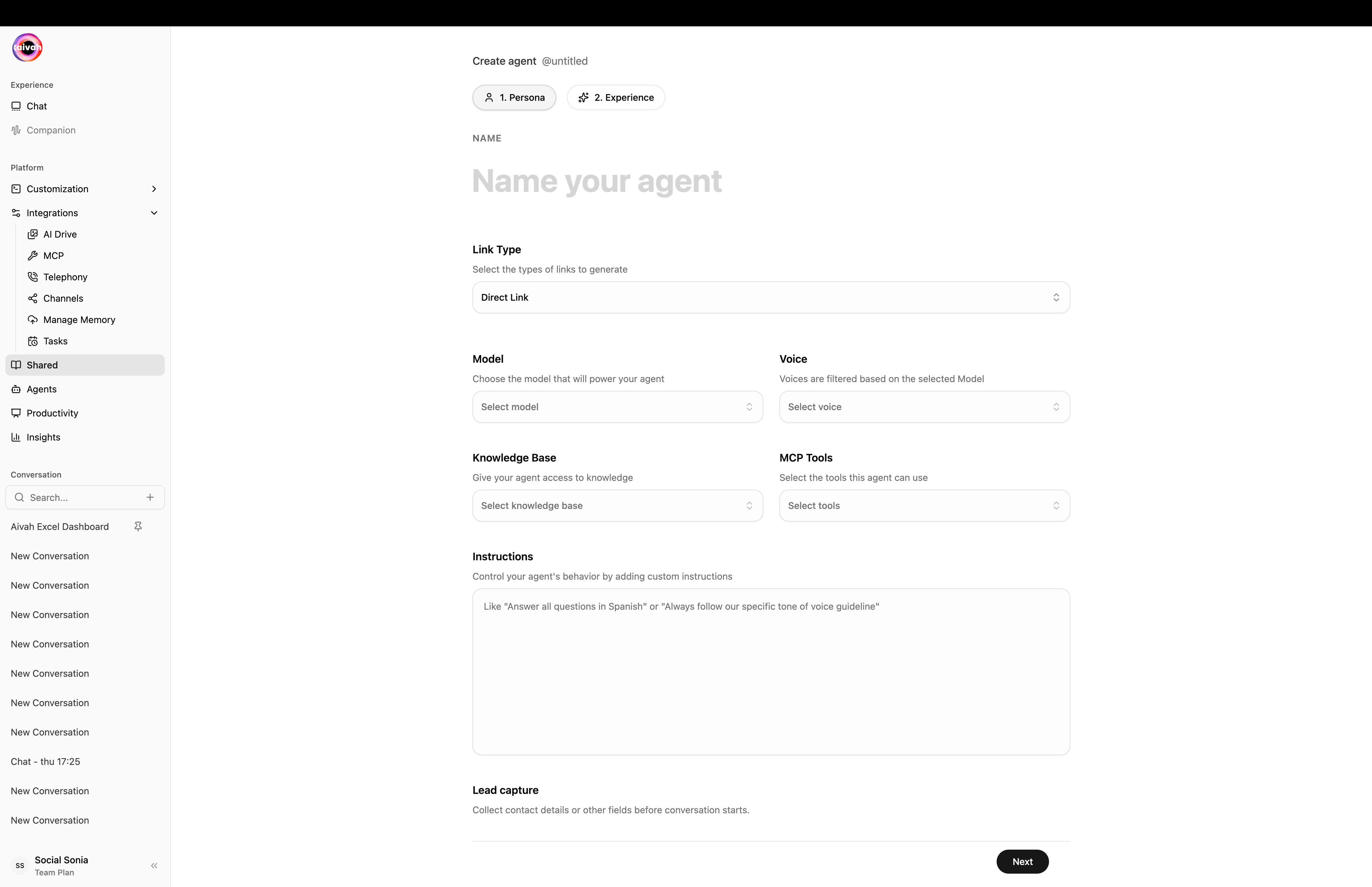
Persona step – Link Type, Model, Voice, Knowledge Base, MCP Tools, Instructions, Lead capture
- Direct Link – a clean URL you can post anywhere.
- Iframe – an embeddable widget for your website.
- Chat Bubble – a floating bubble script for any site.
Optional – add a lead capture form
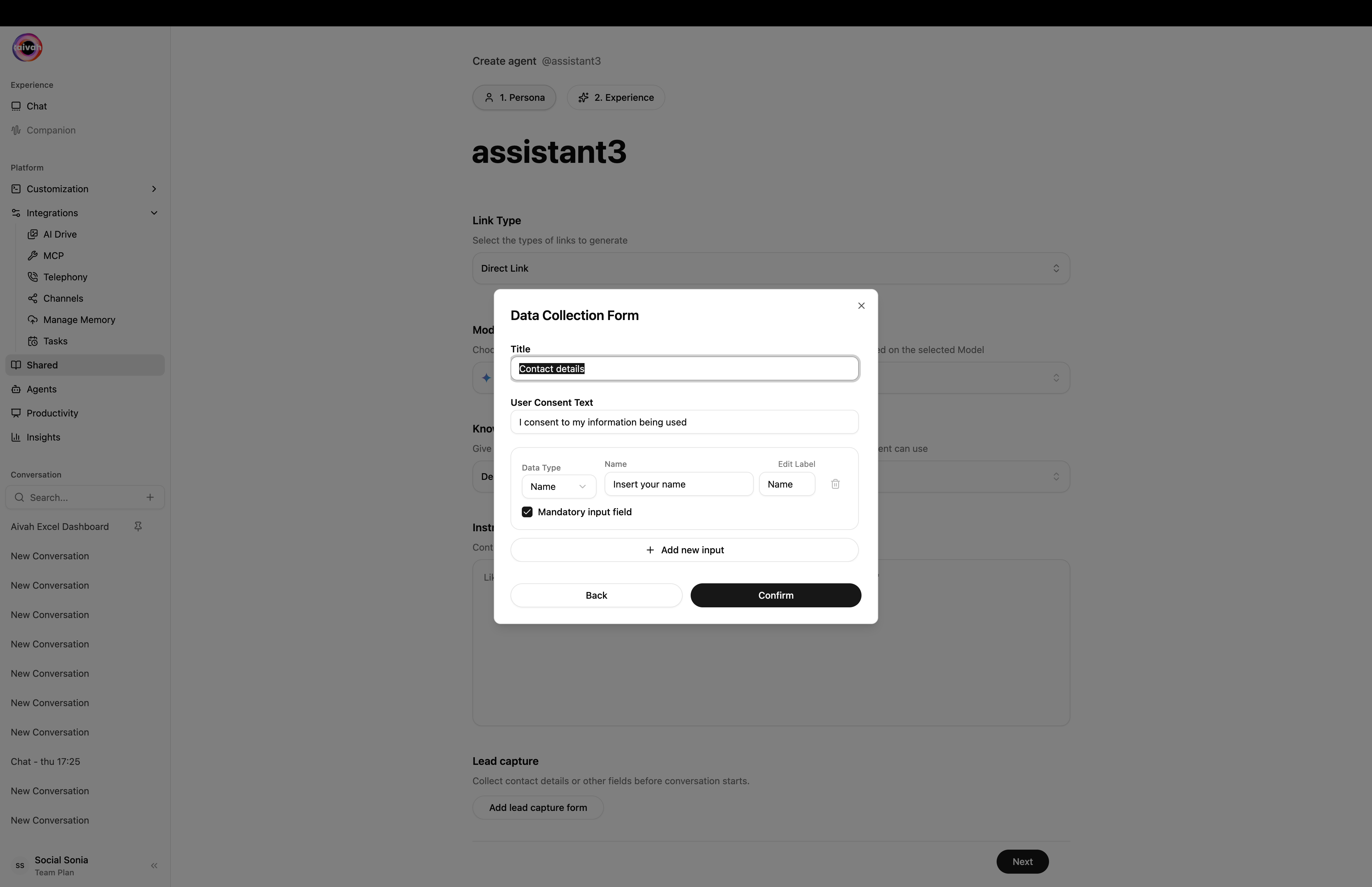
Data Collection Form modal – fields, consent, and a Mandatory toggle
Experience step – pick the avatar / character, scene, and branding
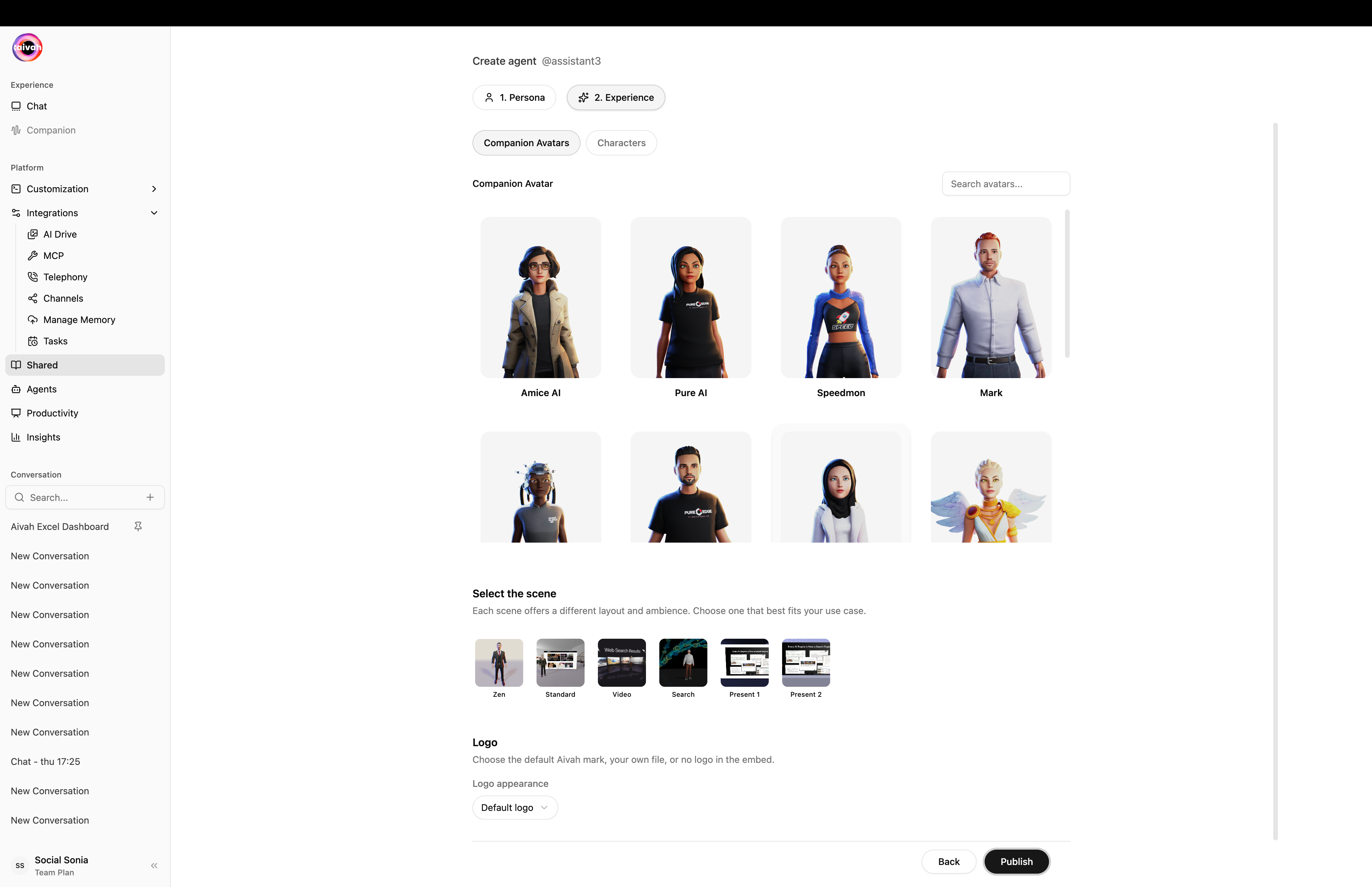
Experience step – Companion Avatars tab with scene picker
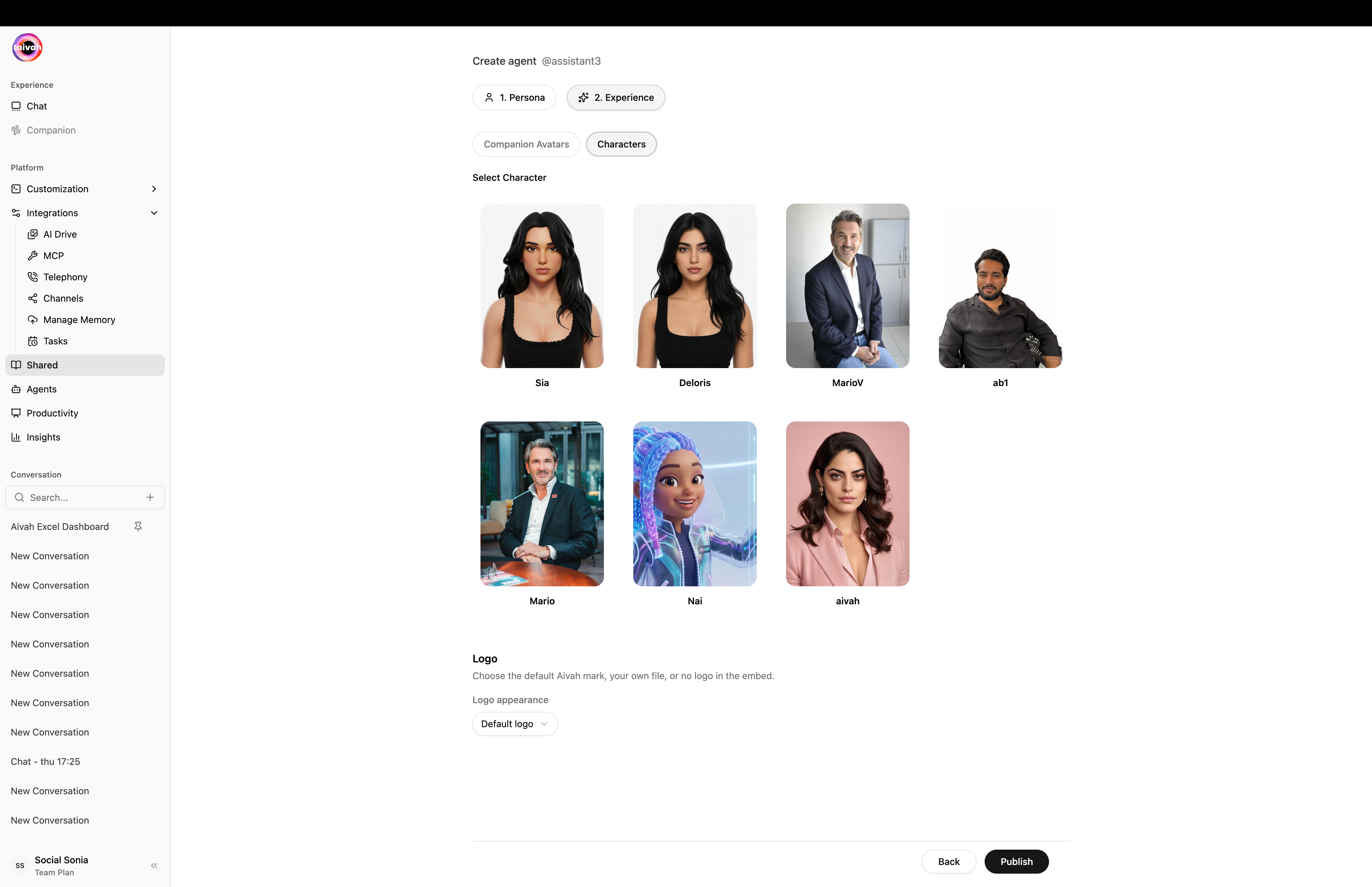
Experience step – Characters tab
Publish
Pick the right distribution
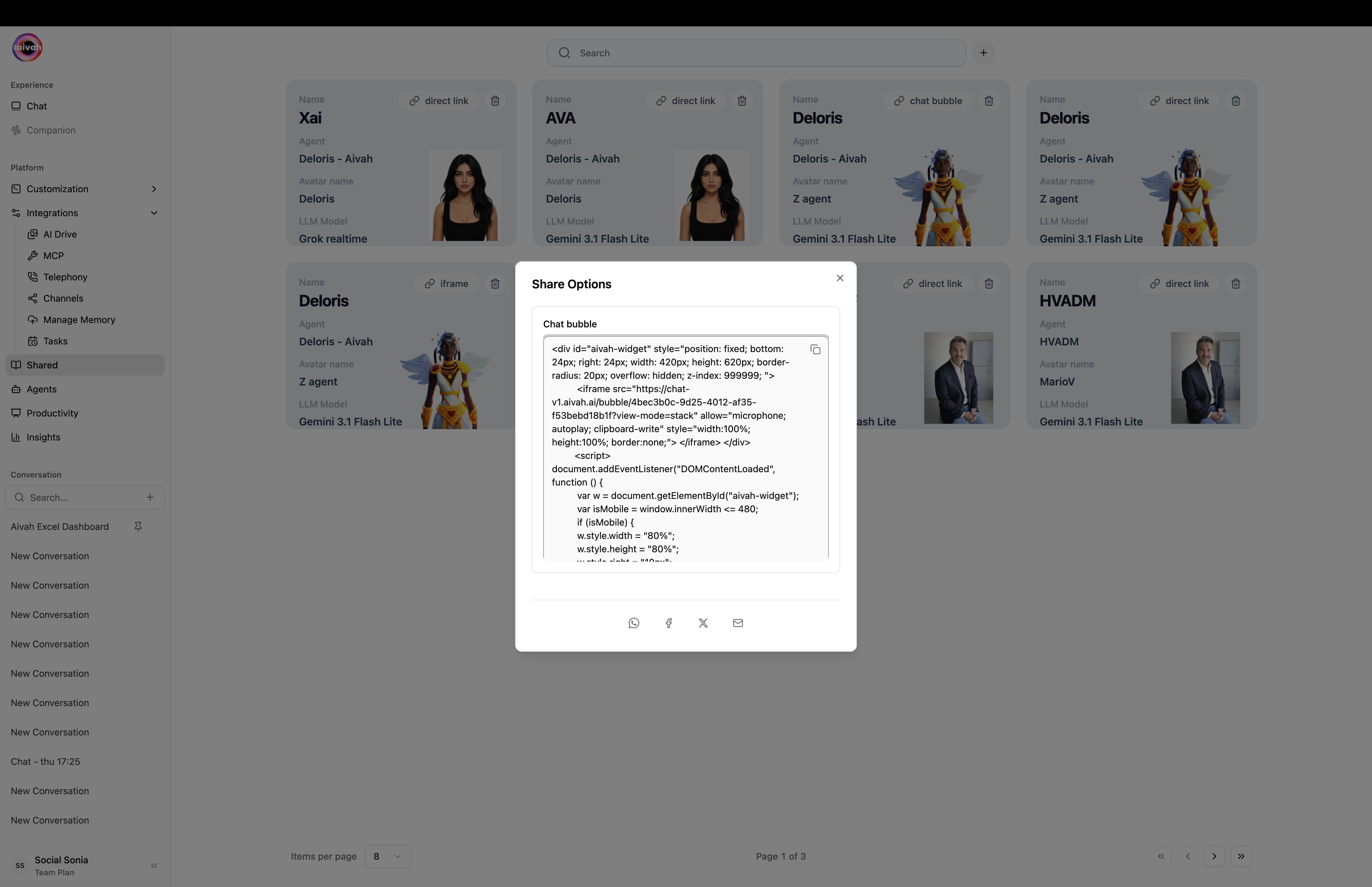
After publishing, the Share Options dialog gives you every distribution snippet for that agent:- Direct Link
- Iframe
- Chat Bubble
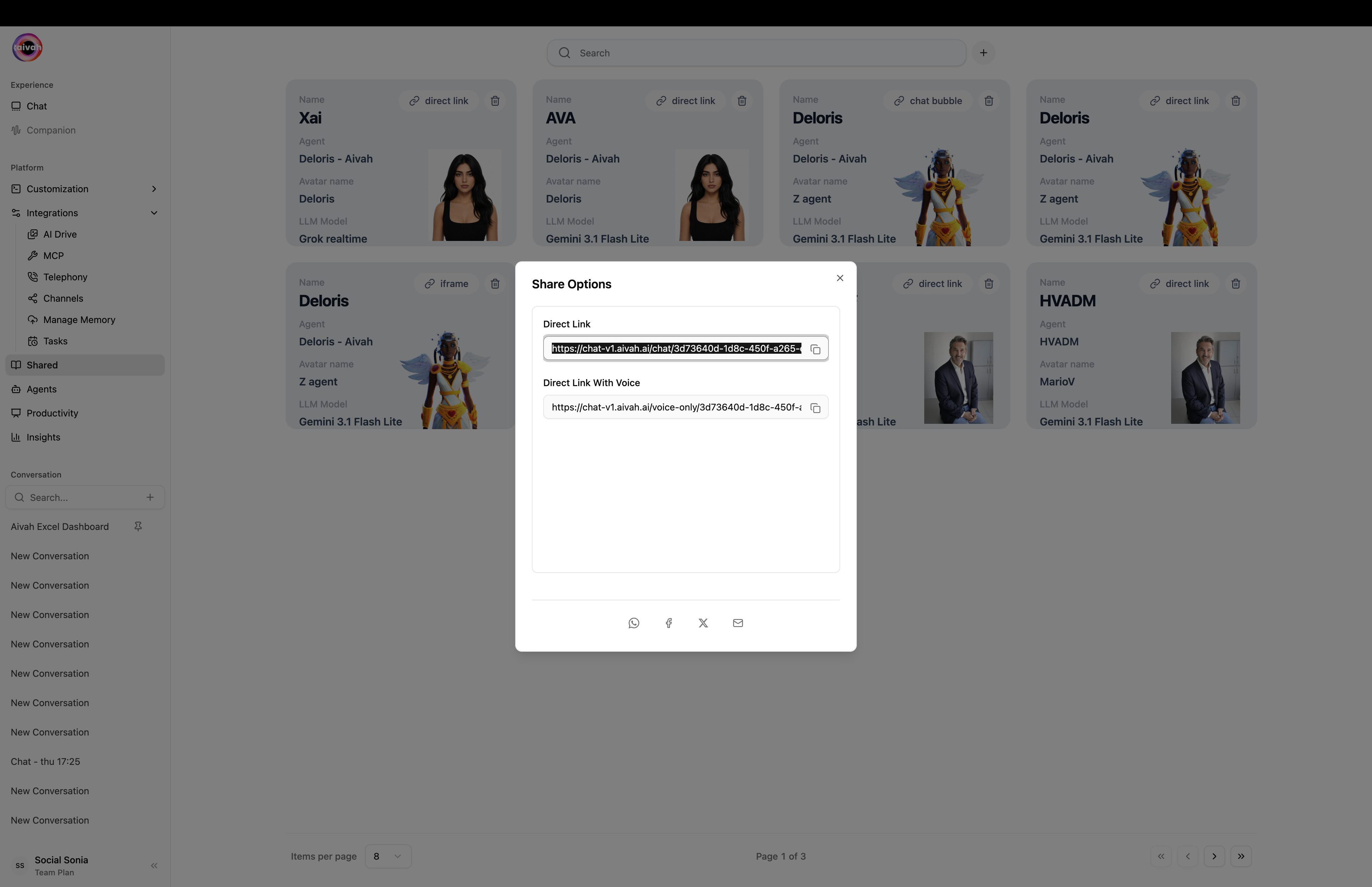
Share Options – Direct Link tab
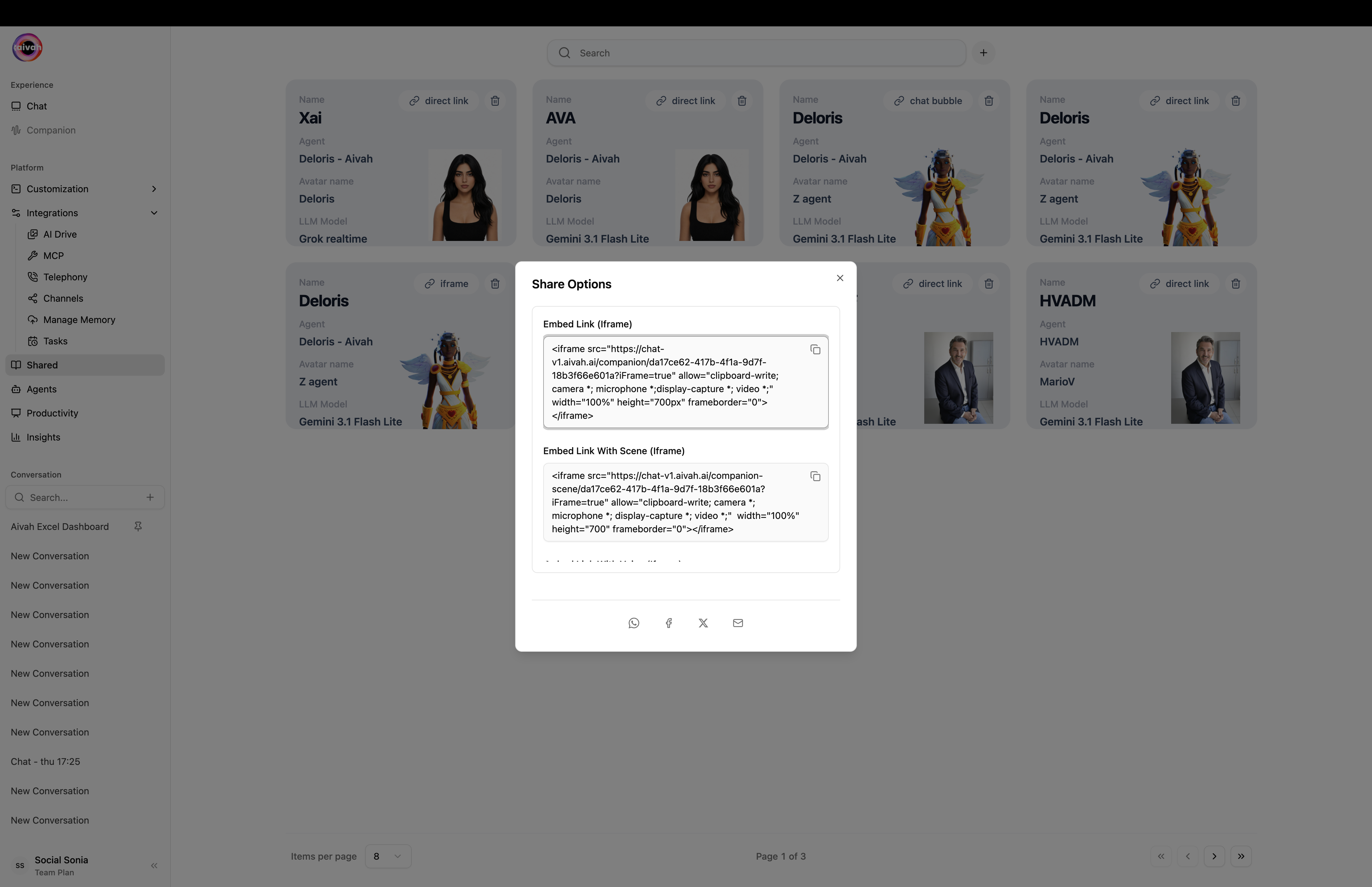
Step 5: Connect Channels and Tools
Open Integrations in the side navigation to plug your agent into the rest of your stack.MCP Tools
One-click OAuth connectors for Gmail, Slack, Notion, Linear, GitHub, Calendar, Drive, Sheets, Outlook, Composio and many more. Toggle on a connector, run the OAuth flow, and Aivah verifies the connection automatically.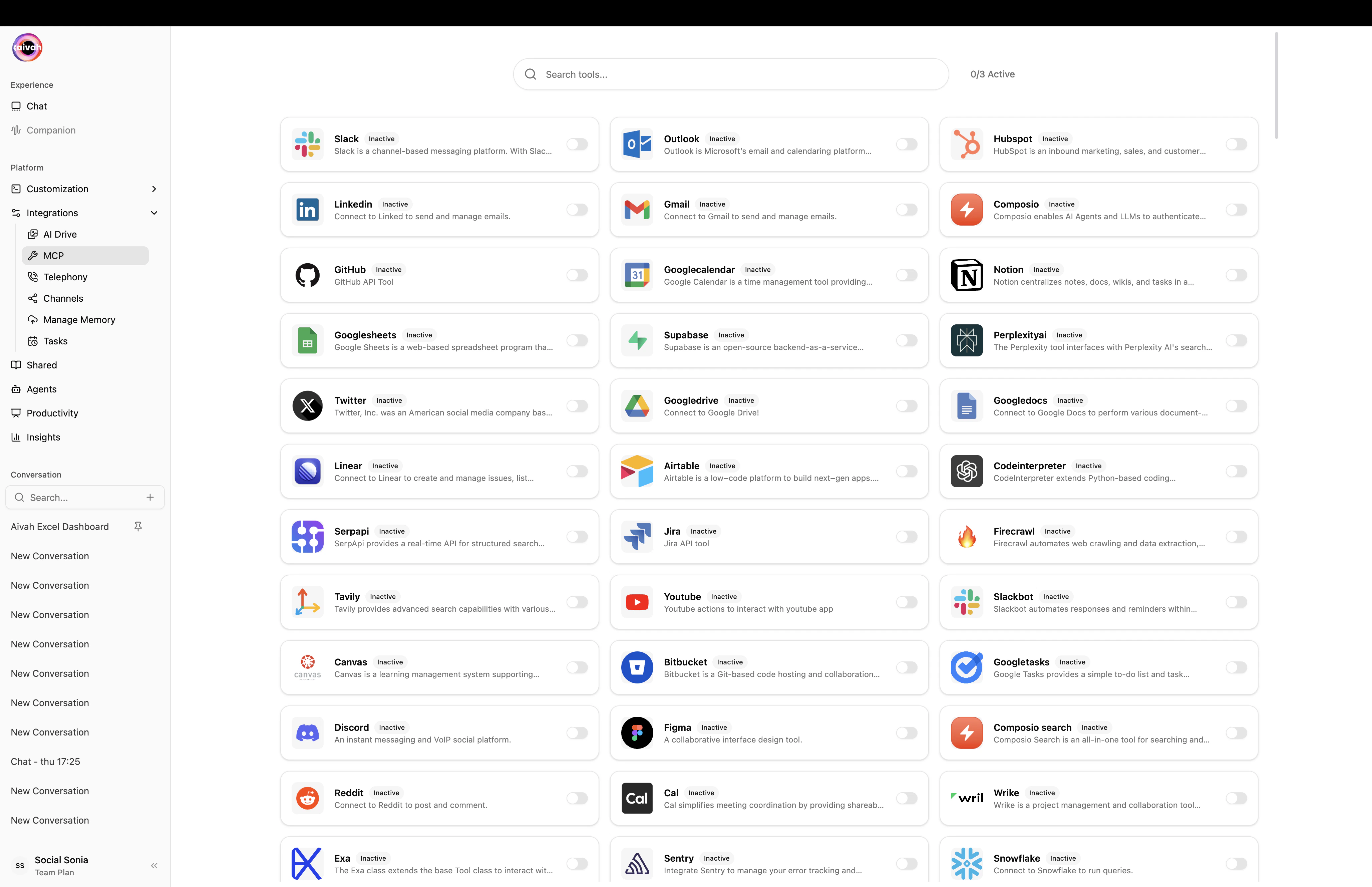
MCP page – every connector with a live X/N Active counter
Channels – Slack & WhatsApp
Let the same agent respond inside your team’s chat tools.- Slack uses the included App Manifest plus a Bot Token, Signing Secret, and your Member ID. Invite the bot then use
/aivah. - WhatsApp uses QR pairing – click Connect, scan the QR with WhatsApp → Linked Devices, and you’re live.
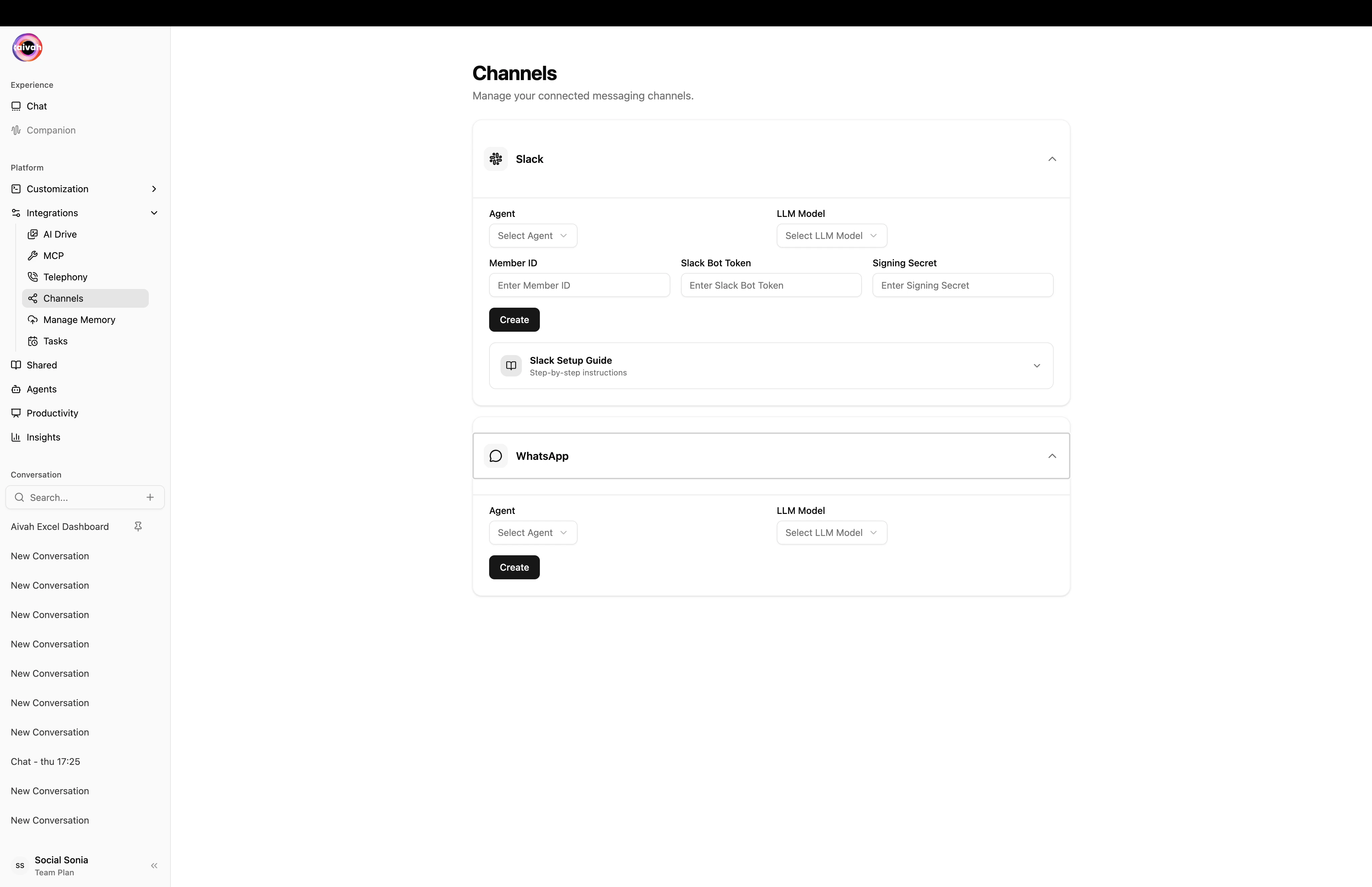
Channels page – Slack and WhatsApp configurations side-by-side
Telephony
Bring your own Twilio number (or mint a free Vapi number). The detail page splits into Connection (SIP URI + credentials) and Interaction (Language Model + Voice + System Prompt) tabs.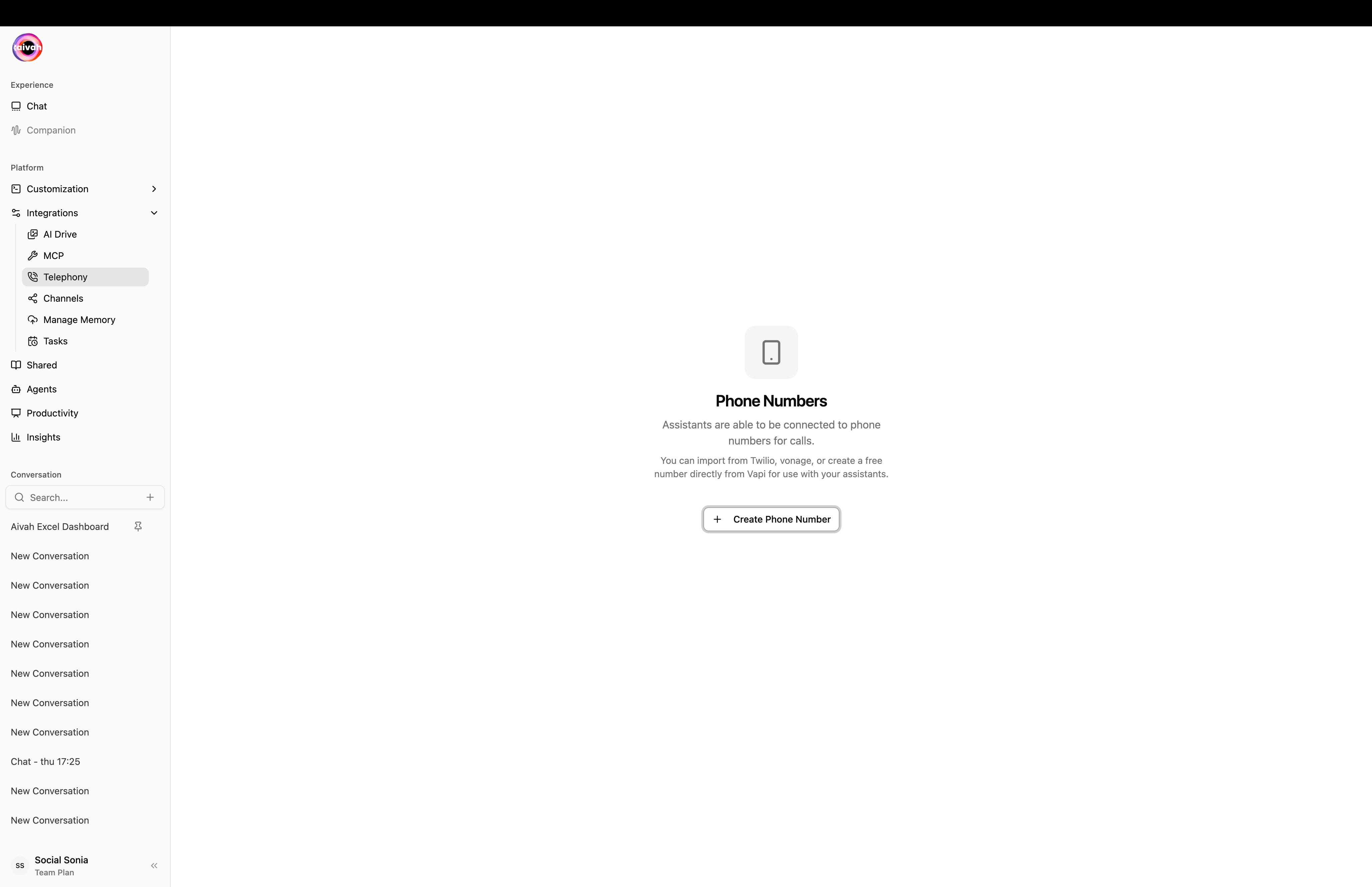
Telephony empty state – click Create Phone Number to add your first one
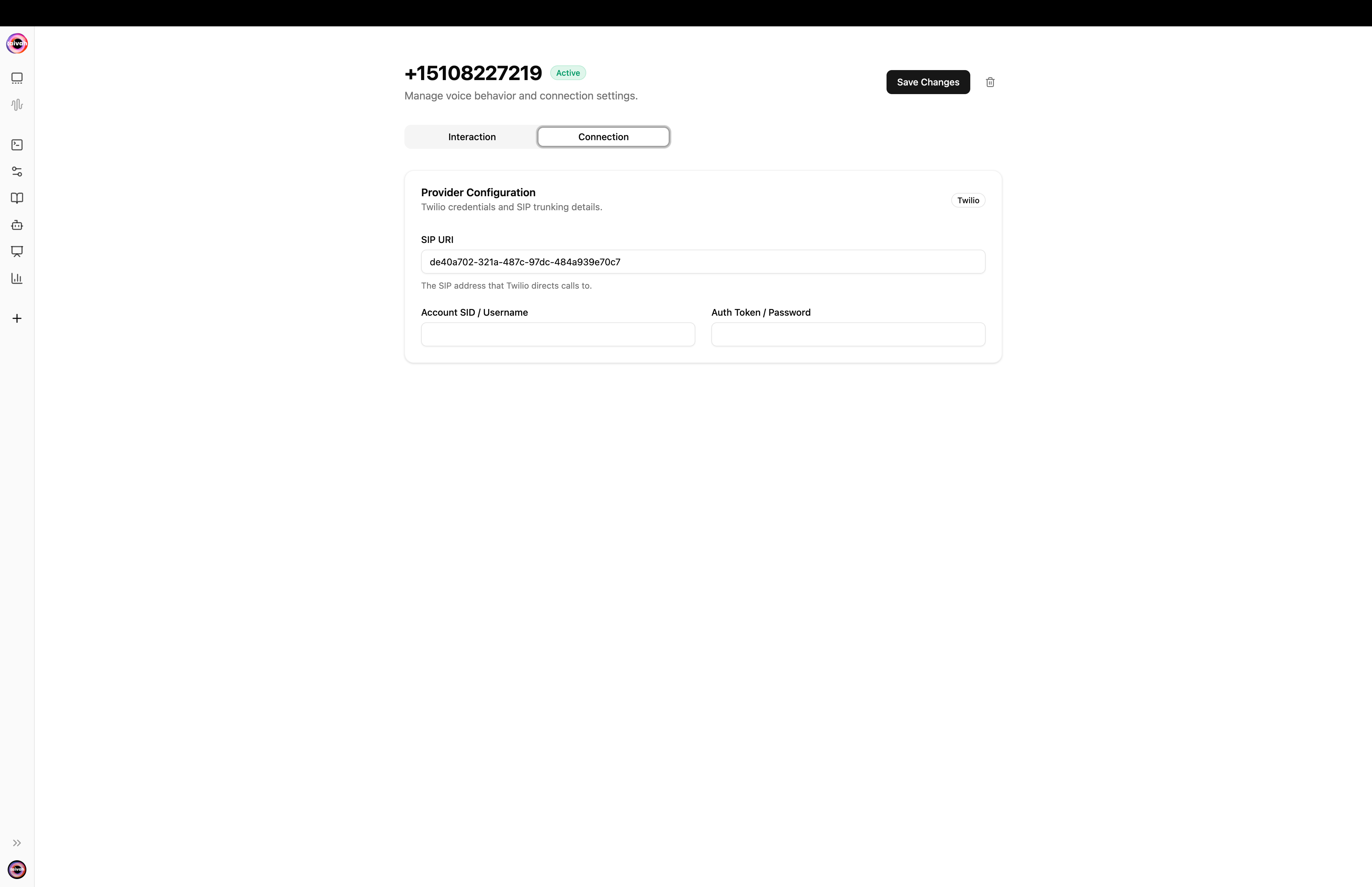
Connection tab – Twilio SIP URI and credentials
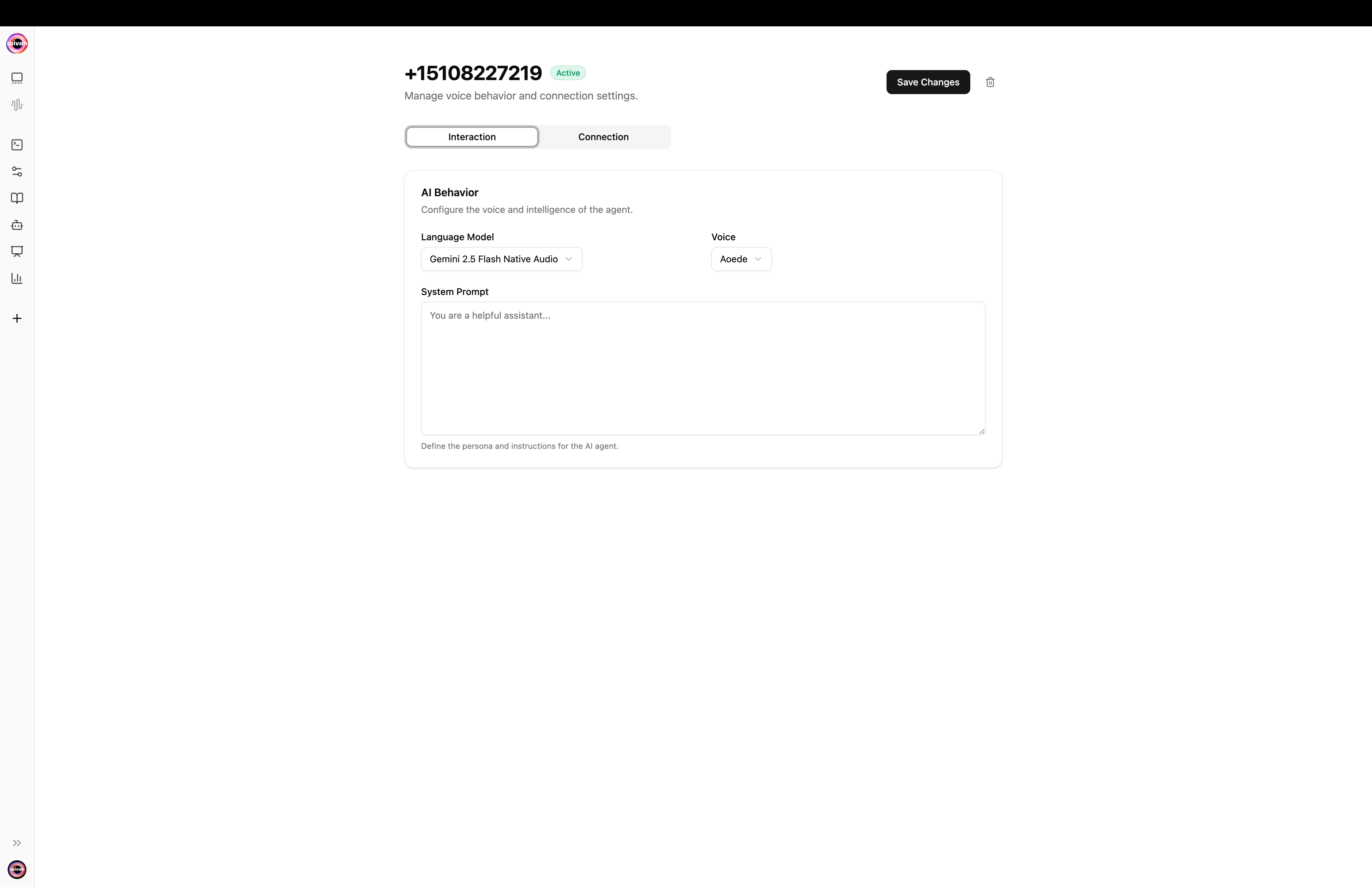
Interaction tab – Language Model, Voice, and System Prompt for phone calls
Tasks – Cron jobs and Heartbeat
Schedule recurring jobs (with a Channel column for Web, Slack, WhatsApp, etc.) or wire up heartbeat monitors. Anything created by you, or by the agent in response to a request, lands here.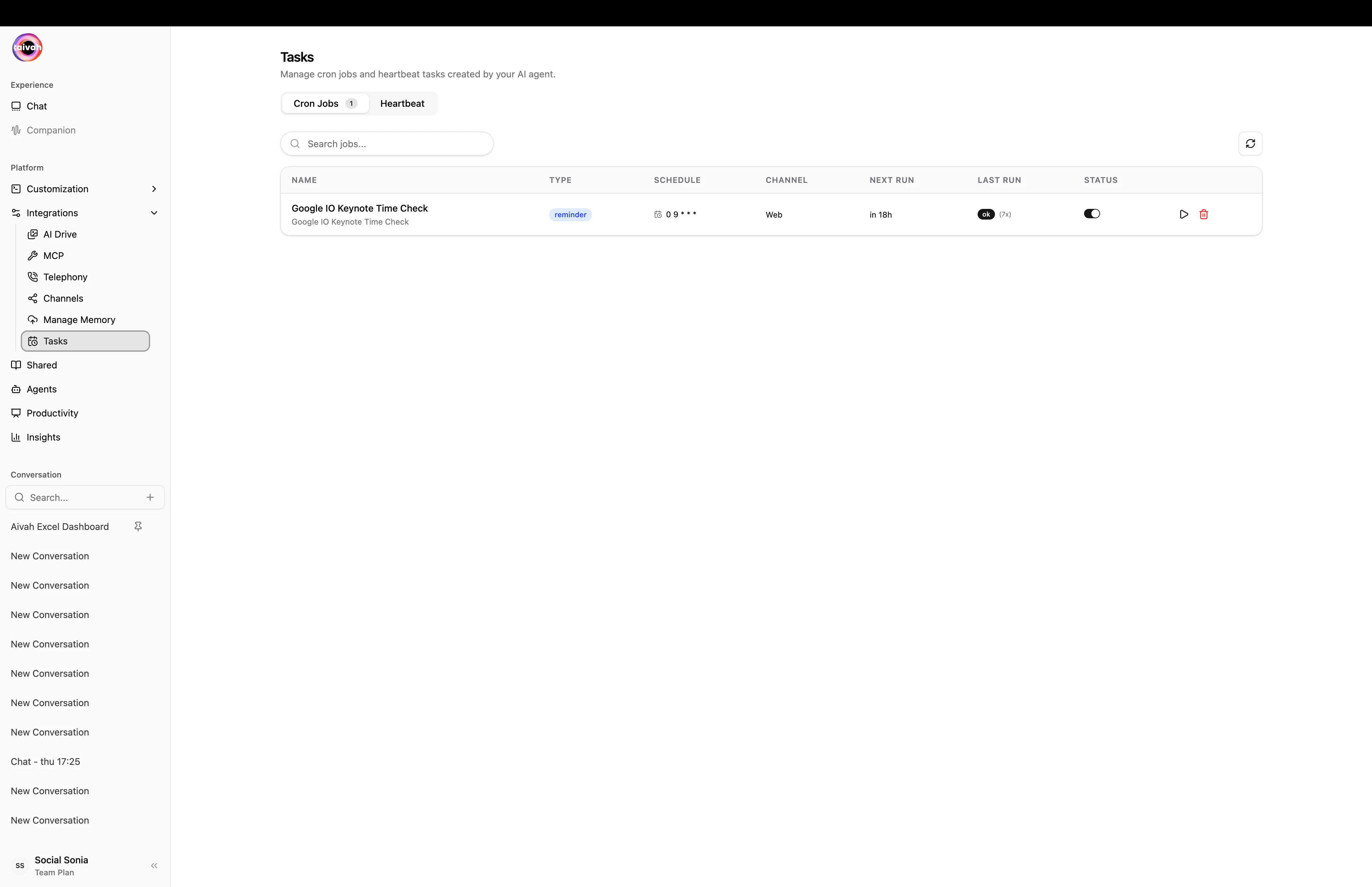
Cron Jobs tab – a scheduled reminder running on the Web channel
Manage Memory
Every long-term key/value the agent has stored, with timestamps and a Download CSV action. Use it for audit, GDPR exports, or quick edits when memories drift.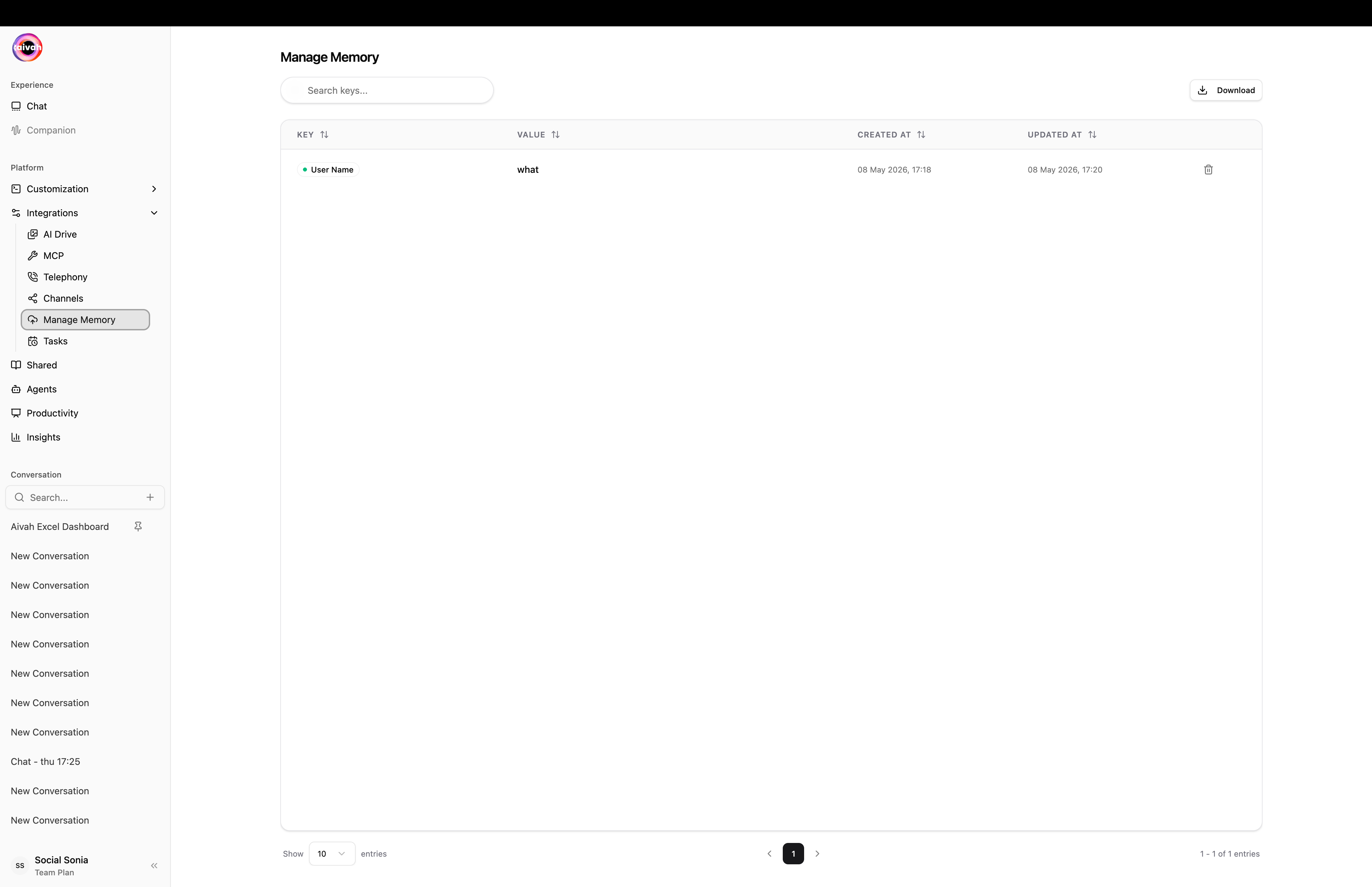
Manage Memory – every stored key/value pair with timestamps
You’re Live
Your AIVAH agent is now:- Trained on your knowledge sources and showing as
completed - Given a face (Avatar or Character) and a voice
- Tested live in the Playground (text, avatar, and voice-only modes)
- Shared with a public link, optional iframe / chat-bubble, and a lead form
- Wired to MCP tools, Channels, Phone, Tasks, and Memory
What’s next
- Best Practices – patterns we’ve learned from hundreds of agents in production
- Productivity – generate slides, podcasts, mind maps – turn the same agent into ready-to-share assets
- Insights – track unique users, credits, chat logs, leads, and call logs
- Subscriptions and Credits – pick a plan, top up credits, and manage billing